
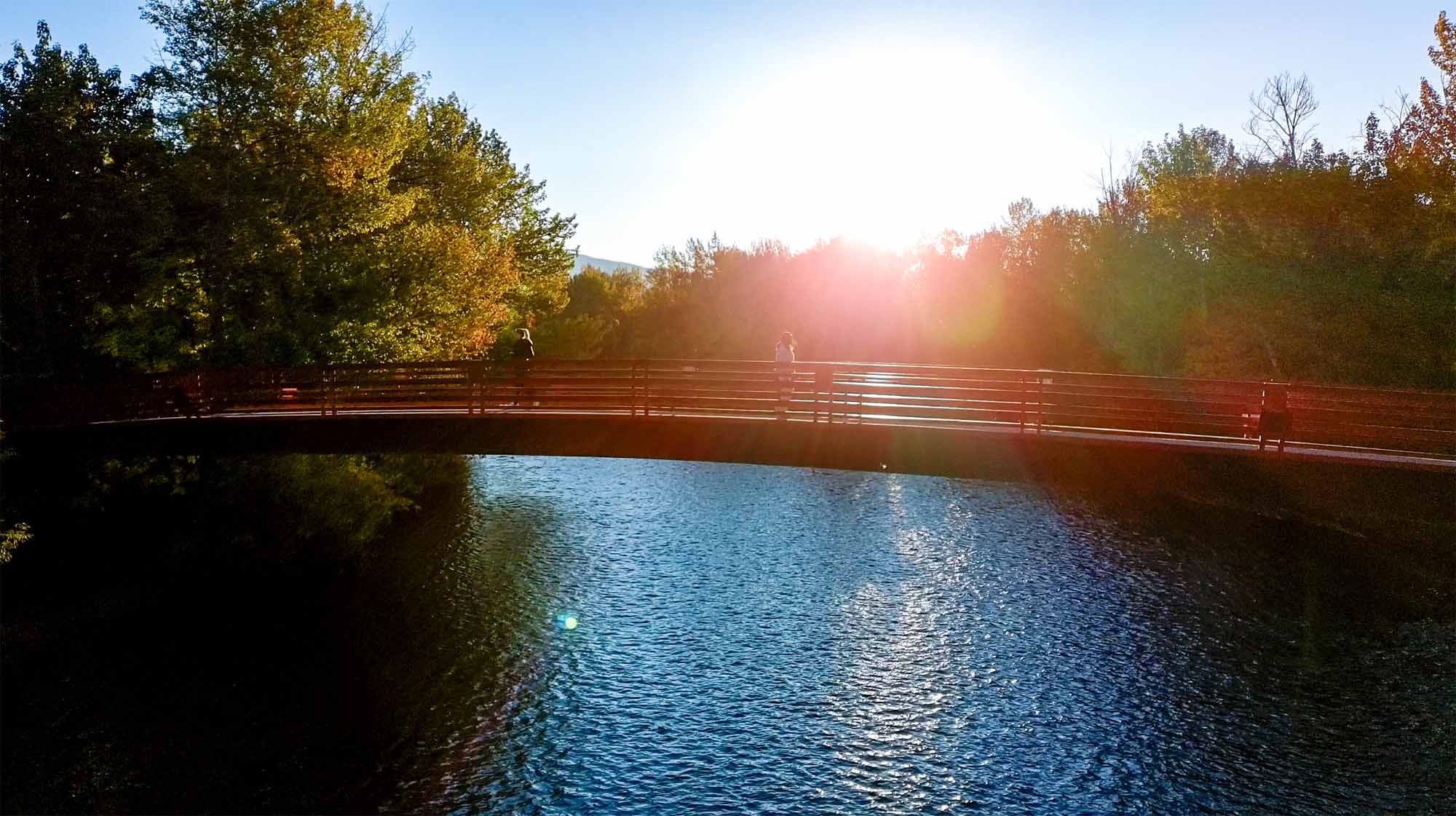
One Saturday morning, a man was walking down the Greenbelt. He looked tired, like someone who had been outside too long. He was talking quietly to himself as he went.
When he came near the Friendship Bridge, he stopped and shouted, “Bridge!” with the delight of a child who has just discovered something obvious and wonderful.
Then, as if some inner channel suddenly cleared, his voice changed. It became calm, almost professional. “Everyone is so happy and intellectual,” he said. “I love that.”
He walked on, still talking to himself, and was gone in a few seconds.
He was right. “Happy and intellectual.” It’s an unusual pairing, and he named it perfectly. Most places seem to make you choose between sharp thinking and genuine warmth. The man on the Greenbelt saw that Boise, at its core, refuses that choice. It’s in the way a stranger will discuss a complex idea with you in a coffee shop, the competence without arrogance you find in local businesses, or the shared assumption that people can be both decent and smart. He saw the city’s constitutional character in a flash of clarity.
This character is precisely what communities need in unstable times. It produces the teachers who make learning contagious, the business owners who serve rather than extract, the neighbors who can hold complexity without cynicism and solve problems without making enemies. These are the people who remember that civilization is built through patient work, not quick wins.
But that character is fragile. It is being buried under the noise of systems that do not understand what they’re crushing. Housing gets built for distant portfolios instead of for residents, creating sterile spaces that push out the very neighbors who organize block parties while also reading zoning code. Schools are forced to manage metrics, silencing the spark of the teachers who inspire. The civic process, which should invite shared creation, often feels decided by forces we cannot see. Each choice for short-term efficiency over long-term meaning drives out the very people who hold a community together. We are not just losing individuals; we are losing the city’s capacity to heal itself.
The man on the Greenbelt, whoever he was, caught the signal through the noise. His sentence was simple, even strange, but it revealed the city’s potential with startling clarity. It reminded us what is real and what is at stake.
The work, then, is not to invent a new identity. It is to clear away what blocks the one we already have. It is an act of stewardship: to quiet the noise, remove the obstacles, and build systems that allow the city’s true signal to come through clearly.
The city spoke. Our job is to build a world that can hear it.
