
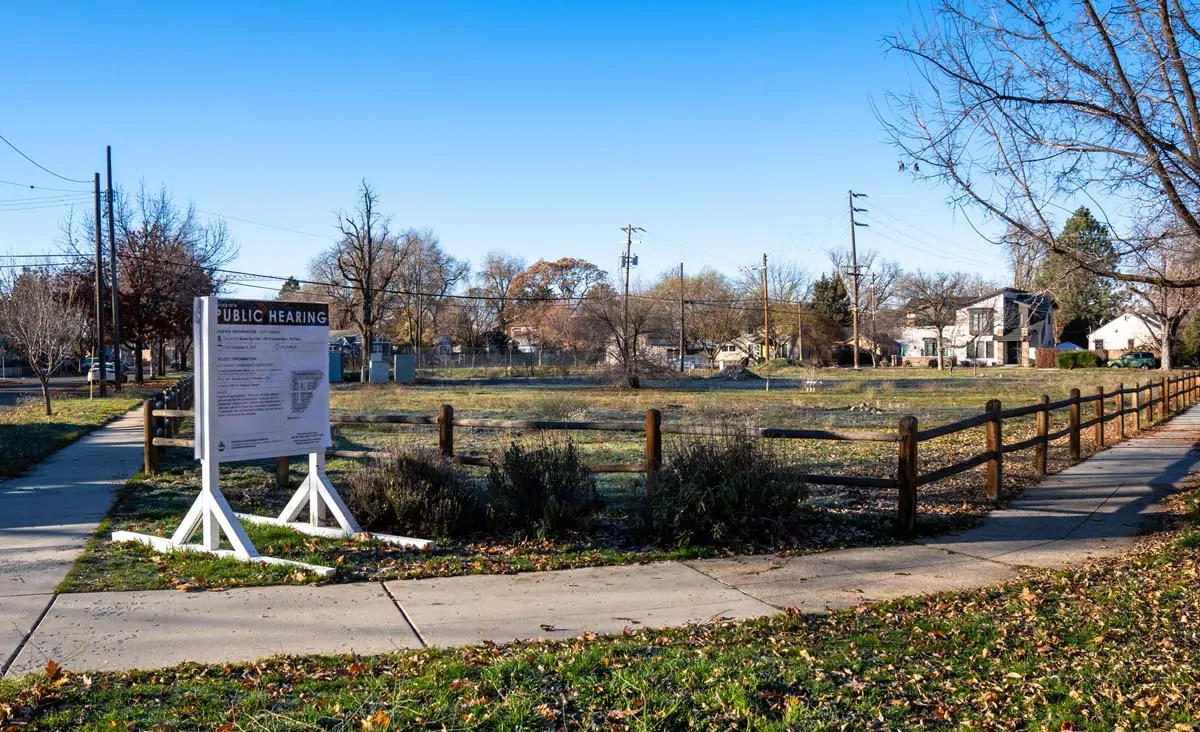
Every growing city has a few empty lots that become more than empty lots.
There is the faded fence, the weeds, the temporary sign, the patch of land everyone passes but no one quite claims. For years it sits there as an unresolved thought in the neighborhood. Then a proposal appears, and the city suddenly knows exactly what it does not want.
The concerns are not always wrong. Cities need review. Neighbors should ask hard questions. A serious community has to care about scale, traffic, materials, affordability, shade, history, and the effect a project will have on the life around it.
But there is a difference between judgment and reflex. One asks whether a thing is worthy. The other only knows how to stop things from becoming real.
That difference matters because public conversations train a city over time. If every proposal is met first as a threat, people begin practicing opposition more than judgment. They get sharper at finding the flaw and weaker at naming the better alternative. The vacant lot remains. Few people love the emptiness, but the community has learned how to delay a bad answer more easily than it has learned how to carry a good one into form. Over time, the lot becomes a civic mirror. It shows whether a community still has the courage to shape the world in front of it.
In 1864, as Boise was moving from frontier settlement toward civic form in the young Idaho Territory that Lincoln had created the year before, a young German student named Friedrich Nietzsche was undergoing his own formation in Europe. That year, Nietzsche graduated from Schulpforta, the rigorous boarding school that gave him his early classical education, and entered the University of Bonn to study theology and classical philology.
Nietzsche was trained to read civilizations through language, myth, inherited values, and the moral assumptions people no longer notice they are living inside. Over time, that training helped make him one of the most influential and disruptive voices of the modern age. Looking at late nineteenth-century Europe, Nietzsche saw a civilization that appeared advanced on the surface but increasingly tired underneath. Its institutions were sophisticated. Its manners were polished. Its intellectual life was crowded with systems, theories, and moral claims. Yet Nietzsche sensed a deeper loss of vitality. Europe, in his view, was becoming too skilled at preservation and too suspicious of creation.
To name the force he believed healthy life required, Nietzsche developed one of his most contested ideas: the will to power. The phrase is easy to misunderstand. Modern readers hear “power” and think of domination, manipulation, empire, ego, or political force. That caution is reasonable. Human beings have often taken the desire to shape the world and corrupted it into control over other people.
The more useful meaning begins with vitality. The will to power describes the drive of living things to grow in capacity, meet resistance, overcome weakness, and shape what is still unresolved. In its healthiest form, it shows up in the artist, the craftsman, the teacher, the founder, the builder, and the steward. It is the part of a person that looks at disorder and feels responsible for making something better.
Nietzsche feared the opposite condition. He gave it a human shape in the figure of the Last Man. The Last Man wants comfort without burden. He wants safety without aspiration. He wants the benefits of civilization without the discipline required to renew it. He avoids the risk of commitment, then calls his avoidance wisdom. He does not build much, but he always has reasons why others should not build either.
Every city has to guard against that spirit. In Boise, the temptation is easy to understand. People can feel the city changing. They see familiar places disappear. They watch new buildings rise too quickly, too cheaply, too carelessly. They worry, often with good reason, that growth will dissolve the character of the place rather than strengthen it.
But fear cannot be the highest civic virtue. A city that only knows how to resist change eventually loses the ability to guide it. The task is not to defend every proposal or bless every builder. The task is to recover a stronger public standard, one capable of saying yes and no with equal seriousness.
The will to build is that standard in action. It is the decision to accept responsibility for a specific piece of the world. A vacant parcel. A failing block. A school day. A public meeting. A neighborhood edge. A civic ritual. A broken system that everyone complains about but no one has yet taken seriously enough to repair.
The will to build requires more than energy. It requires restraint. It requires memory. It requires attention to the land, the body, the street, the neighbor, and the person who will inherit the result. Building without stewardship is only another form of extraction.
Real building is slower and more demanding. It asks what a place is for. It asks what kind of life the work will make easier or harder. It asks whether the result will age into dignity, whether people will gather around it, whether it will lower the friction of daily life, whether it will still deserve care when the first enthusiasm is gone.
That is the difference between mere activity and civic creation. A city begins to recover its will to build when critique becomes attached to responsibility. It is not enough to say what is wrong with a proposal, a policy, a street, or an institution. The harder work is to describe what should happen instead, then stay with it long enough to help make it real.
First, a city has to recover its story. It has to know what kind of place it is trying to become, what it is responsible for protecting, and what kind of future is worthy of effort.
Then it has to design the structures that can hold that story in ordinary life: homes, streets, schools, gathering places, public processes, funding models, standards of beauty, and habits of stewardship.
Then it has to build. Patiently. Publicly. With enough humility to listen and enough courage to act. The empty lot will not resolve itself. Neither will the broken policy, the lonely neighborhood, the careless building, or the civic habit of permanent complaint. These things wait for people willing to move beyond commentary and take responsibility for what happens next.
A mature city takes concern seriously and keeps it from hardening into paralysis. It studies what is proposed, remembers what the place has already been, judges the work against a real standard, and then acts with enough courage to build what the future will need.
That is the will to build: the steady choice to serve the city by giving greater care, order, and dignity to the world our children will inherit.
