
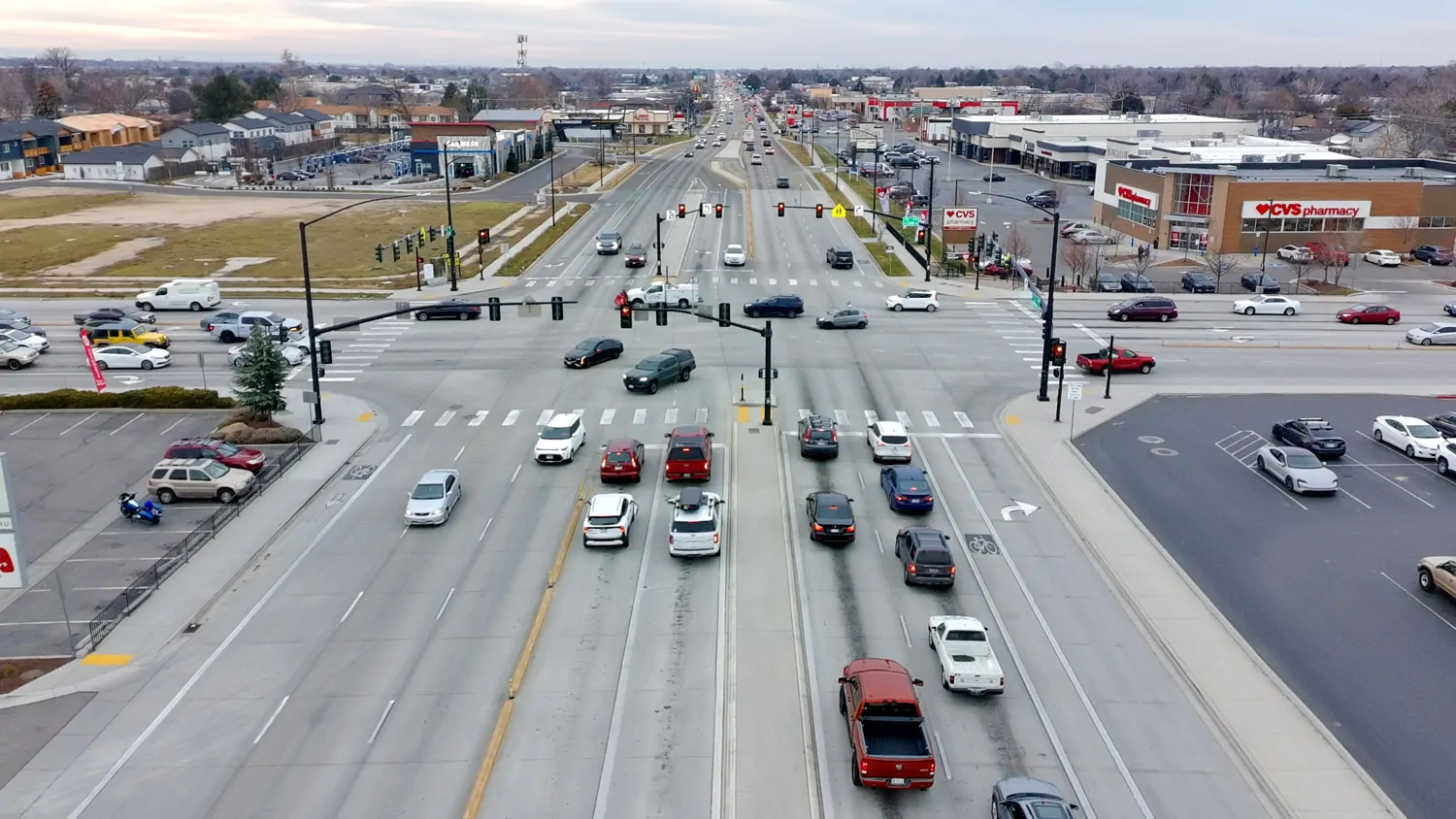
Take a drive down Fairview Avenue or the long stretches of Eagle Road. In those corridors, the city stops feeling like a place and starts feeling like a series of disconnected lot lines. By the time you get through it, you feel scrambled.
This is a biological reaction to a chaotic environment. You are moving through a landscape where every sign, every curb cut, and every parking lot is fighting for your focus. The visual noise—flat signage, massive asphalt setbacks, and erratic traffic—provides plenty to look at, but nothing to see.
These spaces are built to harvest your attention, piece by piece. Every business optimizes for its own visibility, oblivious to the street it inhabits. This creates a sensory scramble that forces you to do all the work of internal organization. You have to manually filter the mess just to navigate a turn lane.
By the time you pull into your driveway, you feel that cost. We often mistake this for the natural fatigue of a workday or a personal failure of discipline. It is actually the price of living in a fragmented field.
We have plenty of information, but the coordination has failed. We are surrounded by data and starved for a pattern.
The Intelligence of the Whole
Biological health is a feat of coordination. It doesn’t matter how well an individual cell functions if it loses its connection to the larger pattern.
Developmental biologist Michael Levin has shown that biological form is held together by a “field,” or a system of distributed signaling that tells cells where they are and what they are supposed to build. Intelligence is distributed throughout the system. Order is maintained because every part “listens” to the shared logic of the whole.
Cancer is the collapse of this coordination. In Levin’s research, it’s seen as a breakdown of attention. A group of cells simply stops listening to the signals of the larger organism. They become blind to the collective plan and begin acting as individuals.
When a cell loses its connection to this field, it defaults to a primitive, short-term intelligence. It eats as much as it can and reproduces as fast as it can, oblivious to the boundaries of its neighbors.
Cancer is local optimization detached from the whole.
The cell isn’t trying to kill the body; it simply no longer knows the body exists. It is operating on a narrow intelligence that serves the part at the expense of the organism. This breakdown begins in biology, but it defines our cities.
When the Parts Stop Fitting Together
A city operates like an organism, depending on the coordination of its parts. It requires a shared logic to maintain social trust and economic stability. In a healthy city, every component talks to the others: a building acts as a boundary that shapes the street, and a sidewalk sets the rhythm of the neighborhood.
This coordination fails when a single project optimizes for itself at the expense of its surroundings. You see it all over the Treasure Valley. A standalone express car wash or a drive-thru dropped onto a transit corridor like State Street.
On a balance sheet, the business is a success. It has high throughput and a strong ROI. But on the street, it’s freelancing. It ignores the sidewalk, creates a dead zone for pedestrians, and breaks the visual pattern of the block. It’s a project that has stopped reading the neighborhood.
This is the urban form of local optimization. When gated subdivisions ignore the street grid, or parking requirements prioritize storing metal over housing people, we lose the thread. We are building a city where the individual lots are thriving, but the city itself is dying of fragmentation.
The Proof of Coordination
To see what it looks like when a field is successfully coordinated, look at an environment often dismissed as mere spectacle: the Disney theme park.
Even if it isn’t a model for civilization, Disney works because it takes the architecture of attention seriously. These spaces function because they remove the guesswork. Through the deliberate use of sightlines, clear thresholds, and spatial rhythms, the design makes the next move intuitive. You don’t have to filter a chaotic field to know where to go; the environment does the organizing for you.
When the attention of a crowd is coordinated spatially, behavior changes. People move with more grace and wait with more patience because they are responding to a coherent pattern. The environment is doing the heavy lifting of orientation, replacing the need for constant, high-alert scanning.
This is the proof of concept. If entertainment designers can use these principles to manage the flow of a vacation, our cities have no excuse for ignoring them. If we can coordinate attention for a spectacle, we can do it for a community.
A City Without a Field
Boise is a city under pressure, but we are misdiagnosing the strain. We track the number of housing starts, the width of the roads, or the speed of the growth. These are measurements of volume, but they tell us nothing about whether the city actually fits together.
The real crisis is that Boise is becoming a city without a field.
When we line our main roads like Chinden or State Street with disconnected projects, we create a mess of information. These spaces are packed with data—signs, lights, and lanes—but they offer no sense of place. In these zones, landmarks are treated like utility poles and our streets are engineered to move cars while ignoring the humans inside them.
Like the cancerous cells in Levin’s research, these projects have become blind to the city as a whole. They optimize for a single lot or a single traffic count while the rest of the city withers. We have built a landscape where the individual lots are thriving, but the community is dying of fragmentation.
Rebuilding Shared Attention
We have spent decades treating the city as a logistics problem. But people don’t thrive in incoherent places. You cannot build a stable community in a city that constantly scrambles the perception of its citizens.
If we want Boise to function as a living system rather than a collection of competing interests, we must rebuild the field. This work goes deeper than design taste; it is about restoring a shared civic logic. We must stop building environments that extract our attention and start building those that hold it.
The task for the builders, the planners, and the neighbors of Boise is to create containers that help the parts rejoin the whole. When we design a street that regulates the eye, or a park that invites a shared rhythm, we are creating the coordination a healthy city needs to heal.
We have enough information. The real work is rebuilding a city where our attention can finally serve a shared future.
