
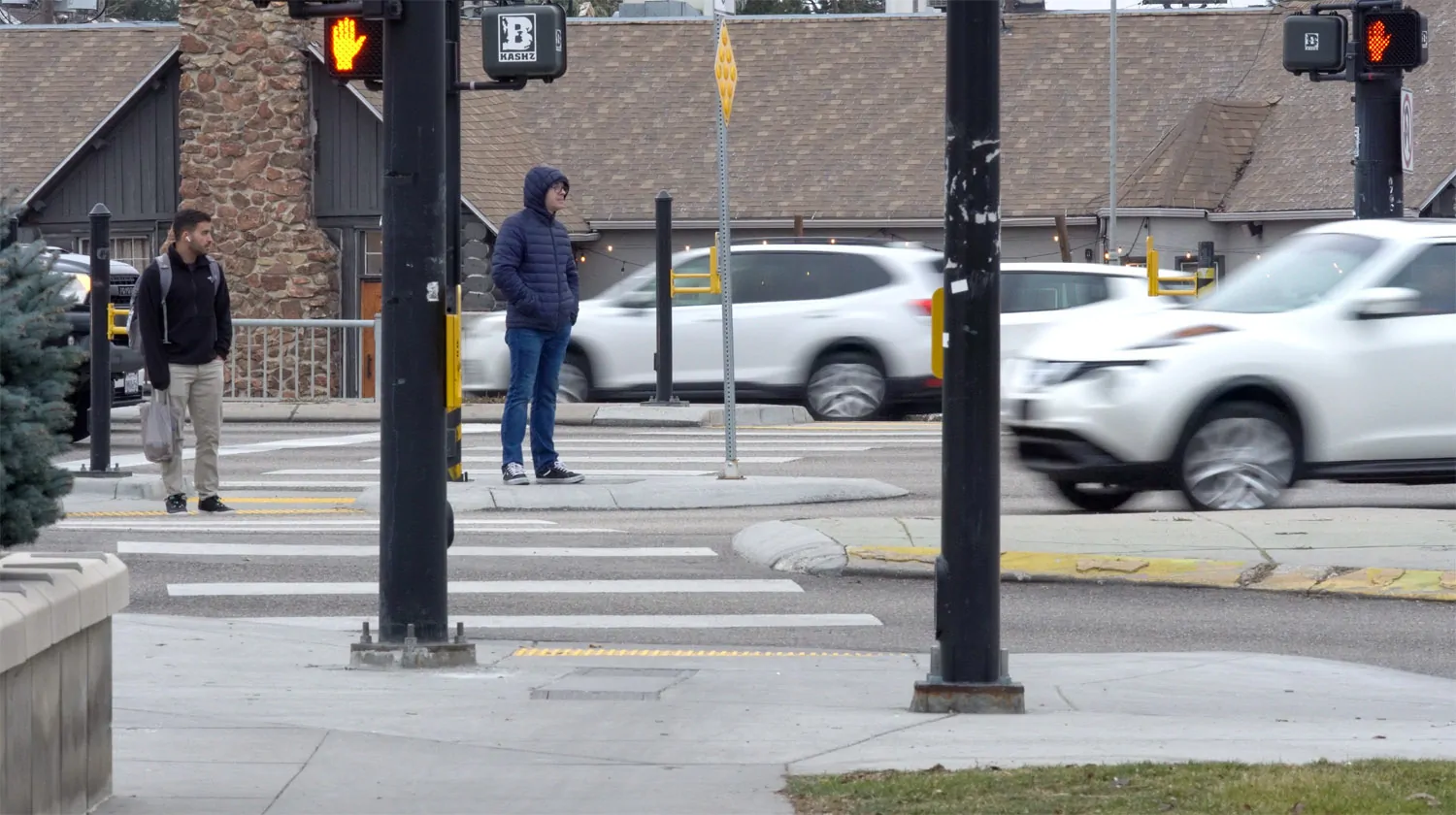
The Crossing
Standing on the curb of a road like Myrtle Street at five o’clock, you are doing survival math with your body.
Scanning the traffic for a gap, you watch a truck approaching, trying to catch the driver’s eye to see if they’ve noticed you. Every muscle is coiled. You burn metabolic energy just to get to the other side. You can cross, certainly, but you have to pay for that movement with a spike in cortisol and a frantic negotiation with every passing bumper.
Now, walk a block down to a marked crossing.
The moment you step into those lines, the script changes. You don’t have to beg for eye contact or guess a driver’s intent; the agreement is already written into the asphalt. Your heart rate drops. Your shoulders loosen. You have transitioned from a state of raw improvisation to a state of pre-negotiated trust.
It is the same twenty yards of pavement. But in the first scenario, you are an obstacle. In the second, you are a participant.
That shift is the entire point of a civilizational container: not to restrict movement, but to store the energy of coordination so individuals do not have to supply it themselves.
The Cost of No Container
When the lines on the asphalt are missing, the burden of coordination shifts to your nervous system.
Without the container, you’re in survival mode. Instead of just walking, you’re calculating velocity, judging the weight of a truck, and guessing whether a driver is distracted by their phone. The driver is doing the same, improvising with a two-ton machine. Everyone is expending massive cognitive energy just to avoid a collision.
This is the hidden tax of an unstructured world. It pushes the entire cost of coordination back onto the individual.
We see this everywhere now. We’ve dismantled the civic rituals and physical patterns that once handled the social traffic of our lives. We’ve traded clear containers for a vague promise of flexibility, and in doing so, we’ve replaced structure with constant strain.
Modern life feels like navigating a series of streets without crosswalks. We are asking people to supply internally the clarity and stability that their environments used to provide. We expect individuals to be their own police, their own community organizers, and their own moral anchors, all while dodging the metaphorical traffic of a fragmented city.
The problem isn’t about individual effort. It’s that we’re building environments that demand an impossible amount of metabolic energy just to stay upright.
The Battery of Civilized Trust
A crosswalk is more than a visual cue. It is a social contract of pre-negotiated trust.
Stepping onto those lines is entering a settlement made long before you arrived at the curb. The law has been translated into a physical form so you don’t have to litigate your right to exist in the street. The conflict between the person on foot and the person in the truck was resolved years ago by planners and engineers.
This is what a good container actually does: it stores coordination.
We often mistake structure for limitation. We see the lines on the road and think they tell us where we can’t go. In reality, structure frees us by reducing the effort needed to move forward.
Without the crosswalk, crossing the street comes at the cost of constant stress and hyper-vigilance. You pay for your movement with your own nervous system. With the container, the environment does the heavy lifting. It offloads the coordination to the infrastructure, allowing your mind to focus on higher-order human things, like conversation, reflection, or just noticing the light on the mountains.
Structure is about conservation, not control. It is the city taking responsibility for the low-level chaos so the citizens can afford to be human.
The Logic Scales
This logic extends beyond the curb. It shapes how we inhabit a city together.
When we remove the “lines” from a neighborhood, a school, or a meeting format, we’re not offering freedom. Instead, we’re pushing everyone back into unstructured negotiation, making them navigate the social traffic of their lives.
Wherever a competent container is missing, people have to improvise from scratch. And improvisation is expensive. When a social environment has no clear thresholds or shared rituals, a predictable and draining pattern emerges:
- The strong dominate: Without a pre-negotiated script, the loudest voice or the most aggressive personality wins by default.
- The anxious withdraw: People with high sensitivity or deep thoughts stay on the curb. They won’t risk the collision of an un-structured interaction.
- Energy is wasted on the ‘How’: Everyone expends valuable energy trying to figure out basic social codes—how to stand, how to speak, where the boundaries are—leaving zero energy for the “What”, or the actual contribution they came to make.
This is the hidden crisis of modern Boise: we have plenty of thriving parcels, but we’ve stopped building the civic crosswalks that actually allow us to navigate and connect.
Whether it’s the threshold of a new rowhouse that clearly separates the private life from the public sidewalk, or a neighborhood ritual that handles the coordination of being a good neighbor, these are the containers that stabilize our nervous systems.
Boise Rising is an attempt to put the lines back on the asphalt of our shared life. We want to rebuild the environmental support that makes self-regulation easy rather than an act of heroic willpower. We want to lower the friction for wisdom by making sure the terms of our common life are already settled in advance.
The Competence Trap
The call for more structure is often misread as a defense of bureaucracy. Mistaking the two is common, but they serve entirely different masters.
A broken container is a hazard. A crosswalk with blind corners, or a pedestrian signal that never changes, is worse than no paint at all because it provides a false sense of security that actually increases risk. When the physical ‘lines’ don’t match the reality of how people move, the container loses its legitimacy. People stop trusting the script and go right back to darting across the street. They choose the strain of improvisation over a system that doesn’t work.
This is evident in our institutions every day.
When a civic meeting is structured around a tiring, rigid format that doesn’t actually lead to a decision, that is a broken crosswalk. When a neighborhood association creates rules that make it harder to build a porch or talk to a neighbor, that is a broken crosswalk. Rather than storing coordination, these systems only manage to generate more friction.
Boise Rising focuses on achieving reality-aligned coordination that functions regardless of ideology or belief. A competent container organizes the environment so that individual competence can surface without the need for coercion. Much like a crosswalk provides the safety necessary for a person to act with grace, better civic design handles the low-level noise of the city, finally leaving us free to inhabit it.
The Stored Wisdom of the City
The true achievement of a civilization is found in the coordination a city has already settled. We tend to measure civilization by its visible achievements—its bridges, museums, and high-rises—but the deeper work is the invisible substrate that makes those places habitable. It lives in the agreements and containers that allow us to move through the world without constant friction.
A healthy city stores coordination in advance. It does not ask each person to improvise the terms of daily life from scratch. This stored coordination is what frees us for higher-order life. It creates the surplus energy required for beauty, play, deep thought, and genuine civic contribution.
Grace naturally arises from this environmental support. It is the surplus energy that remains when the city takes over the work of coordination, leaving the individual free to move without the strain of constant improvisation.
Ultimately, we measure the maturity of a civilization by the volume of chaos the city has already taken responsibility for containing.
The Broken Crossings of Boise
If you want to see where the invisible substrate of our city has cracked, you don’t have to look far. You just have to look for the places where people are being forced to negotiate from scratch.
The corridors of Front and Myrtle Streets are high-stakes barriers for pedestrians. Reaching Julia Davis or Ann Morrison Park requires a constant, high-speed calculation of distance and intent that the environment should have settled in advance. Because the design fails to coordinate the interaction between the person and the machine, the metabolic cost of the crossing falls entirely on the individual. By the time they reach the grass, the effort of simply arriving has already drained the energy the park was meant to restore.
We see the same pattern in our neighborhoods. In parts of West Boise, where the arterials are three lanes wide and the residential blocks are sealed off into cul-de-sacs, the social landscape lacks a script. Without clear thresholds between the private porch and the public sidewalk, neighbors are forced to improvise their boundaries. This low-grade friction often leads to withdrawal; when the environment fails to coordinate the relationship, people stop trying to be neighbors and start acting like islanders.
Our institutions often mirror this breakdown. At public hearings, the process is frequently structured for litigation rather than collaboration. Everyone enters the room coiled for a fight, supplying the civic grace that the format itself should have provided. It is the institutional equivalent of darting across University Avenue at rush hour. It’s a high-stress effort to reach the other side safely.
Boise Rising builds better crossings. Our work—from sunken street concepts to rowhouse layouts—focuses on the physical and social scripts that make coordination easy. We seek to build environments where the work of being a neighbor, a pedestrian, or a citizen is already resolved by the design.
A city of wisdom-seekers deserves the support of competent containers. We are building a Boise where seriousness, safety, and coordination are the default. When the environment takes responsibility for the friction, the citizen is finally free for the work that matters.
Crossing with Dignity
Ultimately, a crosswalk is a moral solution that happens to use the language of engineering.
When we reduce a person to a biological entity dodging a two-ton truck, we have stripped them of their dignity. Dignity arises when survival mode ends. It is the ability to move through your city, free from hyper-vigilance or constant negotiation, as the city itself provides the structure for you to navigate.
We often mistake individual endurance for societal health, praising the grit required to navigate broken systems and absorb daily stress. The maturity of a civilization is found instead in the volume of unnecessary chaos it has already taken the responsibility to contain.
A city that values its people ensures the environment bears the weight of the commute. Reaching a place of restoration—like a public park—should not cost more energy than the destination provides. By treating human energy as a finite and sacred resource, the city builds the containers necessary to preserve it, offloading the friction of the street to the design.
Boise Rising is the work of building the neighborhoods, rituals, and institutions that function as these civic crosswalks. These containers exist to facilitate motion with dignity by resolving the coordination of being a citizen in advance. They represent a standing commitment to the person on the street: the coordination is handled, and the human being is free to exist.
The lines on the asphalt are just the beginning. What we build within them is how we prove who we are.
