
In December 1873, London simply vanished.
A thick “pea-souper” fog, heavy with coal smoke and river humidity, swallowed the city whole. Gas lamps flickered as nothing more than dull, orange blurs. People stood on their doorsteps, unable to see their own feet. For five days, the world’s largest metropolis shrank to a circle barely a yard wide.
Among those lost that week was a local merchant. He had walked the same three blocks from his shop to his favorite pub every evening for twenty years. He knew every crack in the pavement. But that night, the landmarks were gone. The spires, the familiar corners, the carved lintels—all the things that told his brain “here”—vanished into the grey. He was found hours later, three miles away, shivering and near hypothermic. What might have looked like confusion or senility was simply the absence of the feedback he needed to be a person in space.
The modern surge in anxiety is usually blamed on chemistry or personal failure. A “mental health crisis” that lives inside the individual. But the merchant in the fog suggests a different possibility: that when the environment stops providing stable reference points, the mind has nothing to push back against.
Over the last fifty years, we’ve been building a world of glass and sprawl that mimics that same fog. We’ve stripped our cities of the anchors that give us direction and replaced them with a high-speed vacuum. The weariness we feel is the price of trying to navigate a world that has been robbed of its compass.
The Disorientation We Don’t Name
To be lost is temporary. You missed a turn; you can’t find the right street; you’ve drifted from the map. But the map itself still makes sense.
Disorientation is different. It is structural. It happens when the world around you stops providing the reference points—the landmarks, the clear centers, the boundaries that tell us where one thing ends and another begins—that the human animal needs in order to settle.
You can feel this in some of the most ordinary spaces of modern life. Walk out of a big-box store into a five-acre parking lot under a flat grey sky and, for a split second, your compass spins. To your left is a blue box; to your right is a red one. Ahead is a shimmering field of identical asphalt. Every direction looks like ‘away.’
That hollow feeling in the chest is usually treated as anxiety, as though the problem begins and ends inside the person. But in that parking lot, the brain is simply looking for a North Star. It searches for anything that says ‘here’ and finds only ‘anywhere.’
That is the thing we keep getting wrong. We treat that hollow feeling as a personal glitch to be managed. Something to be solved with a better meditation app, a more disciplined morning routine, or a louder set of opinions. We look for a ‘center’ in our screens or our ideologies because we can’t find one in our streets. But the struggle is frequently embedded in the physical world itself. We are asking the individual to supply the internal clarity that a competent environment should have already provided. When the city stops teaching us where we are, the body stays in a low-grade search mode. It’s a cost embedded so deeply into daily life that most of us have forgotten we’re paying it.
Orientation Is a Biological Requirement
Before any living thing can decide what to do, its nervous system must first know where it is.
For humans, this is a biological need. We are the descendants of creatures who survived because they could read the arc of the sun, the flow of a river, and the jagged silhouette of a mountain range. For most of human history, the environment itself provided our orientation, serving as the reliable guide that allowed us to focus on everything else.
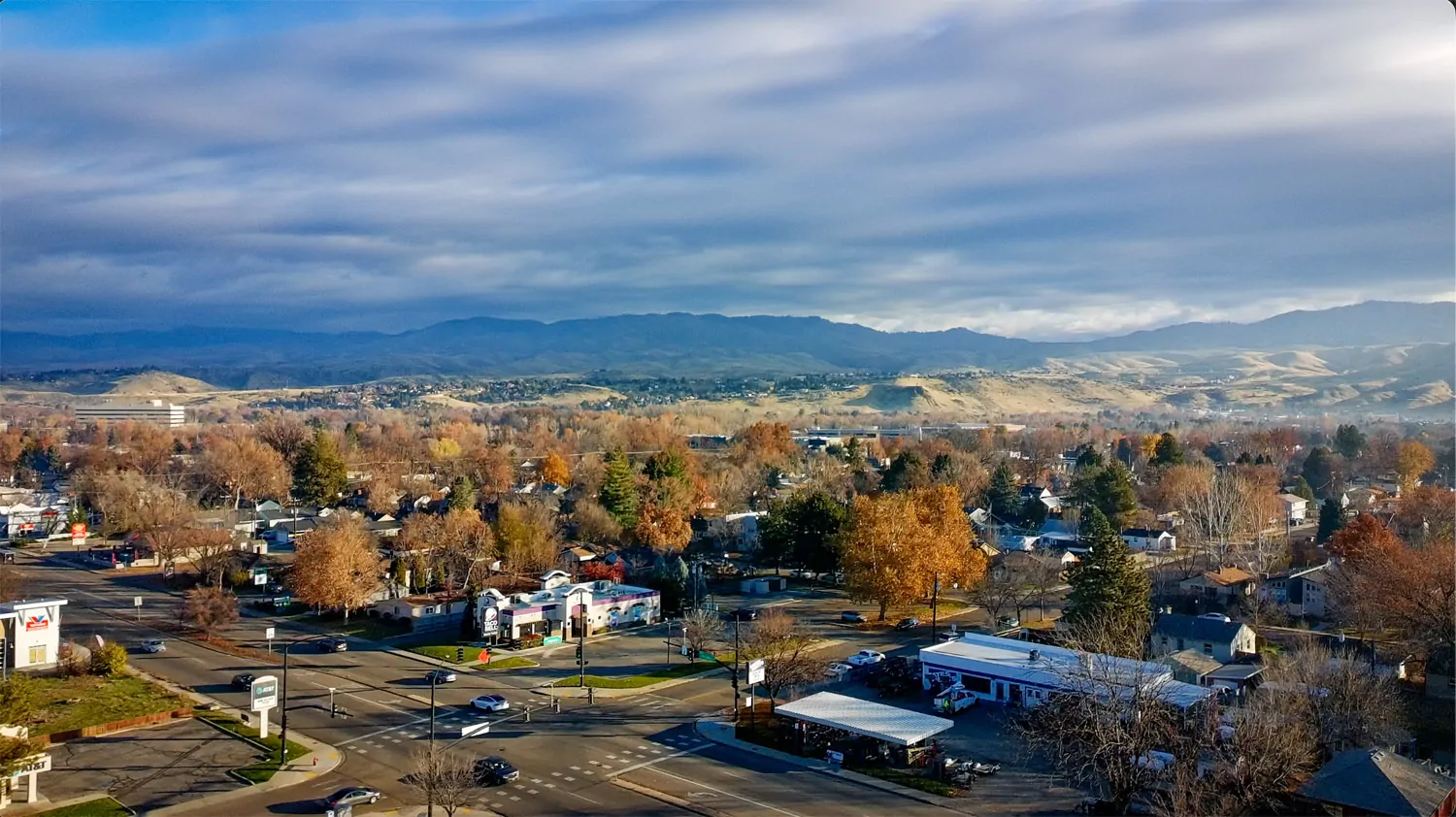
When you stand in a place with a clear center and visible boundaries—like looking toward the Foothills in Boise—your brain can relax. The environment provides a fixed point, and your internal navigation system can power down. You don’t have to compute your location every five seconds. You can simply be. This sense of being grounded is what allows you to act, create, and participate in shared life.
But in the cities we’ve built over the last few decades, this sense of rest is lost. When a city is a collection of identical glass boxes and endless sprawl, your brain doesn’t get the cues it needs. The landmarks don’t exist in a meaningful way. You’re left in a constant state of searching.
That’s when your nervous system stays in high-alert mode, using up its energy just to stay oriented. It is a subtle, relentless form of work. And we often mistake this biological fatigue for a personal failure, as if it’s a focus problem or a cultural issue. But in reality, it’s the fatigue of trying to navigate through a world that has been flattened.
A city that makes sense, that has clear streets and landmarks, isn’t just a nicer place to live. It’s a tool for the brain. It handles the basic question of “where am I?” so you don’t have to, leaving you free to focus on what truly matters.
The Architecture of Anywhere
For most of history, cities were not mere collections of buildings; they functioned as orientation tools. They were built with an intuitive logic that mirrored how we move and see. A central square told you where the heart was. A spire or a clock tower gave you a reference point visible from blocks away. Streets weren’t just pipes for moving cars; they were paths, each with a beginning, middle, and destination. Even something as simple as a transition from public sidewalk to private porch gave you a signal about where you stood in the world.
But over the last several decades, we changed the goal of our environment. We stopped designing for legibility and started designing for throughput. We prioritized efficiency over the human need for orientation.
The result is more than aesthetic failure. The problem with modern development is that it is interchangeable. You could be dropped into a suburban subdivision in Boise, Phoenix, or Charlotte, and if you don’t spot a license plate or a specific mountain range, you wouldn’t know where you were for ten minutes. The houses are the same, the setbacks are the same, and the shopping centers are built from the same three variations of glass and beige stucco.
In this environment, the city is no longer acting as a teacher. It stops giving the brain the unique ‘handshakes’ it needs to build a mental map. When every corner looks like the last, the body cannot form a sense of place. It has to work harder just to maintain a feeling of being present.
This is what makes modern sprawl so biologically demanding. It is a sensory vacuum that forces the brain to stay in a state of high-gear navigation, even for simple tasks like driving to the store. We’ve built a world where ‘here’ is constantly replaced by ‘anywhere.’ When a place offers no feedback to the human need for direction, it feels like an emotional drain. It’s the unintended consequence of efficiency that forgot the person it was meant to serve.
The Search for a Substitute Center
The strain of living in a disoriented environment shows up in our behavior. When the physical world stops grounding the nervous system, the human animal does not simply remain neutral. It begins to look for substitutes. We have a fundamental, driving need for a ‘center’: a sense of where we are in relation to everything else. And if the street doesn’t give it to us, we’ll try to find it elsewhere.
This is the hidden root of much of our modern fretfulness. When you spend your day navigating ‘anywhere’ spaces—interchangeable corridors of glass and asphalt that offer no unique feedback—your body stays in a state of heightened vigilance. This chronic, low-grade unrest is often interpreted as a cultural or political problem, but it is frequently just the sound of a nervous system that can’t find its footing.
Without a physical center, we seek refuge in digital noise and ideological certainty. We look for a sense of “place” in our screens because our neighborhoods have become unreadable. We lean into aggressive identity signaling or rigid tribalism because those are ways to draw a boundary in a world that feels boundaryless. These behaviors are often seen as moral failures or a lack of character, but they’re more like someone groping around in a dark room, trying to find something solid to hold on to. We are trying to stabilize ourselves in a vacuum.
This is where the “Having” mode of modern civilization traps the human spirit. At the most basic level, Having refers to a world of possession, consumption, and throughput. The primary focus is on owning things, moving fast, and optimizing for efficiency. The city, in this view, is nothing more than a logistical grid. One block is as good as another, and the only metric that matters is how quickly we can move through it. Everything is designed to be interchangeable, and the environment is optimized for speed instead of connection. The ultimate Having environment is a collection of interchangeable storage units connected by high-speed pipes. In this world, you are a consumer, not a participant.
But that’s not the only way to live. “Being”—a more fundamental, human mode—is about participation, connection, and presence. To truly inhabit a life, you need to have a specific ‘where.’ You need a place with a unique character, a clear center, and recognizable boundaries. You can’t just ‘be’ anywhere. You need to be somewhere. Somewhere that holds meaning, and speaks to the human need for roots.
When we deprive the world of those landmarks to make it more efficient for the Having mode, we make the Being mode almost impossible to support. Instead of places that help people rest, we build spaces that demand constant transit and speed. This leaves us physically in one place, but mentally and spiritually searching for another. We end up drained by the effort of trying to find a home in a world built only for movement and consumption.
Anchoring the Soul Through Design
If we want to change how a society thinks, we usually start with its stories, its books, its films, or its political rhetoric. But there is a much older and more constant story being told every time a person walks out their front door. The built world is how a civilization communicates its values to the nervous system. It is the physical foundation that either grounds us or keeps us in a state of perpetual displacement.
Every street or square answers three essential questions for the human body: Where am I? What matters here? and Where do I belong? When the environment is legible, the answers are immediate and calming. You are in the heart of the city; the courthouse spire or the library entrance tells you that civic life and knowledge are the priorities; and the scale of the sidewalk tells you that you are a participant, not an obstacle. But when the answers are unclear—when the courthouse is a mirrored box behind a parking garage and the ‘center’ of town is just another interchangeable intersection—no amount of window dressing can fix the disorientation. You cannot talk a person into feeling oriented if the ground under their feet is shouting that they are ‘nowhere.’
Orientation isn’t applied to a city through signs or murals. It’s embedded in its very structure. It comes from scale: the way a building relates to a human body. It comes from proportion: the rhythm of windows and doors that invites the eye to linger. It comes from permanence: the sense that a place has stood long enough to become a reference point for more than one generation. This is why placeless development feels so corrosive. It offers the Having mode convenience of more square footage or easier parking, but it removes the Being mode foundation of anchorage.
To fix the modern sense of fragmentation, we need more than just better narratives or ‘placemaking’ band-aids. We have to look at the physical substrate itself. A healthy city is one that handles the baseline work of orientation so that the citizen doesn’t have to be a hero just to find their way. When we design for stability, we are doing more than building houses; we are creating the physical conditions that allow a human life to finally feel at home in the world.
The Infrastructure of Presence
When we talk about ‘renewing’ a city, the conversation usually turns to economic growth targets or new cultural branding campaigns. But if the primary crisis is a structural loss of direction, the solution has to be structural as well. True renewal doesn’t come from a slogan or a shiny campaign, but begins with the slow, challenging work of re-aligning the city with what people really need. We often try to fix our social fragmentation by asking people to change their behavior, but we ignore the fact that they are trying to inhabit an environment that is constantly pushing them off balance.
Re-orienting a city is a practical task of engineering stability. It means building places with clear centers where people can orient themselves and feel at ease. It means building streets that actually teach you which way you are headed, using vistas, terminal landmarks, or a rhythmic change in scale to guide the body through space. It means favoring buildings that feel rooted and intentional, rather than provisional structures that look like they could be folded up and hauled away in a decade.
This is a matter of biological alignment: designing spaces that meet the fundamental human need for stability. We require landmarks with enough continuity to serve as permanent reference points in our mental maps. When an environment is legible, the body is finally allowed to settle, and the low-grade unrest of the city begins to still. A community’s nervous system can only truly rest in a world that is structurally anchored. Renewal is simply the work of giving the city back its ability to provide solid ground.
The Natural Compass of the Treasure Valley
Boise still holds a rare biological advantage: it is a legible world. Between the vertical lift of the Foothills to the north and the consistent thread of the River to the south, the city provides a natural compass. In much of the modern American landscape—the flat, interchangeable grids of cities like Houston or Phoenix—the horizon offers no feedback. It is a canvas of ‘anywhere’ where one direction is as good as another. But in Boise, you can stand on a street corner, look up, and know exactly where you are.
The Foothills act as our Z-axis. They are the ultimate permanent landmark, an orientation system that doesn’t require a battery or a screen. The earth literally rises to tell you your location. Similarly, the Boise River functions as a legible boundary. It tells the body where the city ends and the water begins, providing a clear limit that a highway—which is a purely logistical tool for throughput—can never offer. These are more than scenic views; they are the anchors that allow our nervous systems to find a resting point.
This legibility is a gift, but it is not a guarantee. As we grow, we face the possibility of building our way into the fog. If we allow development to turn its back on the river, or if we build in a way that obscures the hills, we risk breaking the city’s compass. We are taking a naturally orienting place and forcing it to become disorienting.
Protecting these reference points is about protecting the view-shed of the soul, or the physical visibility of the things that keep us grounded. The growth of the city is inevitable, but its legibility is a choice. We have the opportunity to channel our energy into coherence rather than chaos. We are accountable to the future not just for the number of houses we build, but for the clarity of the world we leave behind. The task is to ensure that as Boise expands, it remains a place where a person can still find their way.
A City That Knows Where It Stands
A person’s ability to live well depends on their knowing exactly where they are. This is a baseline requirement for the human animal, and a city is no different. When the physical world loses its center, the lives built on top of it become fragile. We often search for a sense of ‘here’ in our screens or our ideologies, but that hunger remains because it is fundamentally a physical need for a North Star.
The work for Boise is a matter of structural accountability. As we grow, we have a responsibility to sustain the landmarks and the legibility that make this valley a home. But physical geography is only the starting point. A true compass tells you where North is, but it also gives you the confidence to move through the world with purpose. Our streets, squares, and buildings must take that natural orientation and weave it into the daily movement of the citizen. We are choosing between a city that functions as an interchangeable logistical grid and one that serves as a container for human presence. This is the task of giving the city back its foundation.
To build a city that supports human life, we must restore its ability to help people know where they are. The streets, buildings, and landmarks must be designed to align with the natural environment, creating an intuitive, stable space where people can feel grounded and participate in a shared life. When the environment provides this clarity, it becomes possible to stand on solid ground, to move through the city with a sense of direction and belonging.
