
On many Boise sidewalks, walking is allowed and staying feels faintly out of place. The pavement may be continuous. The curb ramps may be present. A bench may sit nearby, exposed to traffic and afternoon sun. Each element performs its assigned function, yet the whole setting gives the body a simple instruction: keep moving.
There is little reason to stop. No edge offers shelter. No small center gathers the route. The nearest comfortable seat belongs to a café or lobby, where staying usually comes with a purchase. A person can pass through without ever arriving.
This distinction between passage and presence is easy to miss because the city remains accessible in the narrow sense. The road reaches the destination. The sidewalk reaches the door. The parking lot stores the car. Daily life keeps operating. Yet ordinary public life has very few places to settle between one task and the next.
The same instruction continues after people leave the sidewalk. Leisure now tends to mean the weekend, a vacation, a hobby, a workout, an evening of streaming, or a few hours set aside to recover. Even rest carries an assignment. Sleep improves performance. Exercise restores energy. A trip returns the traveler refreshed enough to resume work.
When every break serves the next round of production, work continues to govern the day. In his 1948 book Leisure: The Basis of Culture, Josef Pieper described leisure as a form of receptive attention: celebration, contemplation, conversation, gratitude, and the ability to encounter the world before asking what use can be made of it.
In this older meaning, leisure allows a person to be present as a whole human being, free for a time from the roles of worker, customer, commuter, patient, student, or taxpayer. Culture grows in that freedom. People notice what is beautiful, remember what they have inherited, and practice forms of life worth carrying forward.
That kind of time needs a setting. A meal offers the simplest example. Food answers a biological need. A table can turn that need into a shared form. People sit face to face, wait for one another, tell stories, mark occasions, disagree, reconcile, and return. The table protects a small interval from the pressure of the rest of the day. A daily necessity becomes a shared ritual because the table gives it a place and people return to it.
Public life develops in much the same way. A market needs a ground that people recognize and revisit, just as a neighborhood requires a corner where paths naturally meet. Public memory needs visible places where what has been inherited can remain present. Conversation needs settings where people can linger without blocking traffic or explaining their presence.
City systems are usually built around tasks. Roads carry traffic. Sidewalks get people to doors. Bus stops mark where the vehicle arrives. Parks are measured by facilities, plazas by scheduled events, and housing by units produced. Those functions keep a city operating. Trouble begins when the public realm is judged only by whether the task was completed.
Then a bench is judged as an installed object, a sidewalk by its width, and a plaza by the events it can accommodate. The human question recedes: can someone be here well on an ordinary Tuesday? The body answers before the planning document does. Full sun shortens the visit. Traffic noise keeps attention alert. An exposed bench allows rest in theory while making vigilance the more natural response.
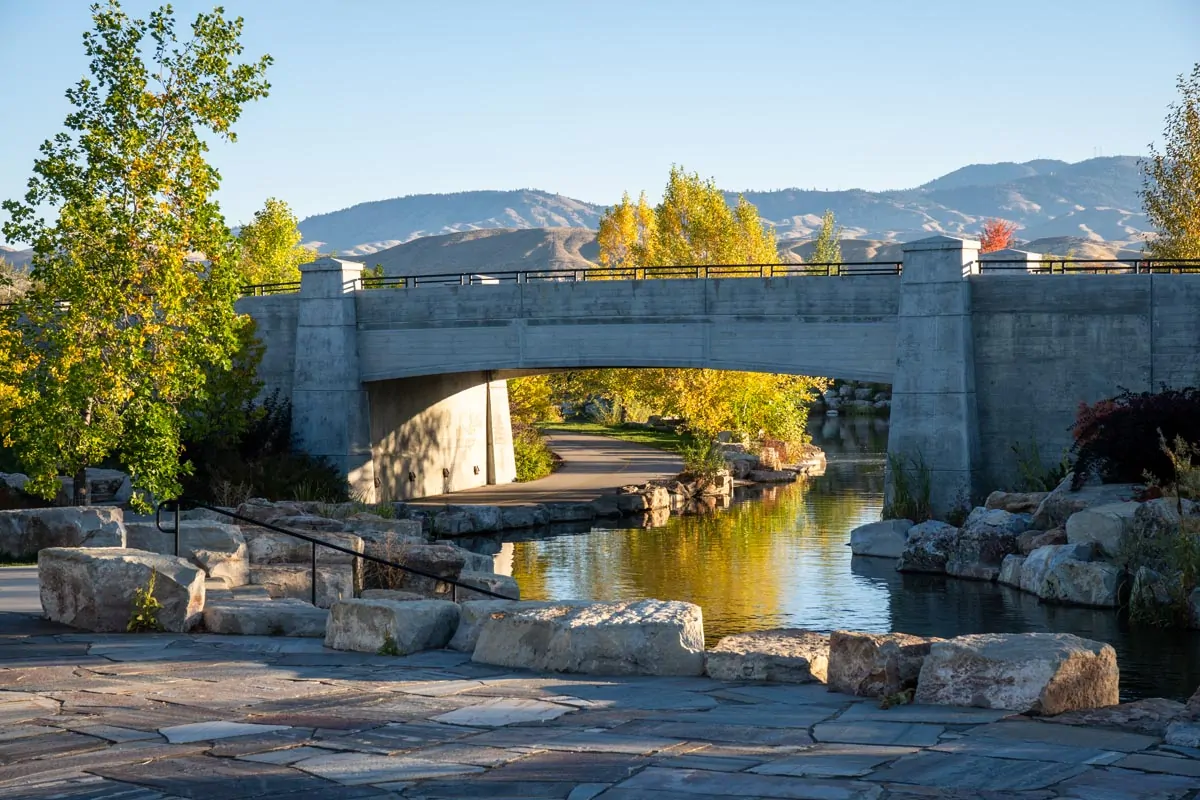
Boise already knows the value of places that answer yes. The Greenbelt carries movement through shade, river views, familiar pauses, and destinations. The foothills give walking a sequence of departure, effort, outlook, and return. Parks hold picnics, games, reading, and time with children and elders. Seasonal markets, concerts, and festivals temporarily give streets and plazas a shared rhythm.
Boiseans already seek out places where movement comes with beauty, safety, and room to pause. They also expose an imbalance. Nature, recreation, and scheduled events carry a large share of Boise’s public life, while much of the ordinary built city remains organized around driving, parking, private parcels, commercial interiors, and narrow strips of pedestrian access. A person may leave a shaded trail, cross into a commercial corridor, and find the whole experience change within a few hundred feet: wider asphalt, louder traffic, longer crossings, fewer trees, and nowhere obvious to stop.
An event can fill a plaza for an evening. The harder task is making the same ground hospitable the following afternoon, when no stage or vendor explains why anyone should stay. Daily culture depends on that ordinary permission. It grows through recurring greetings, children taking the same route to school, elders watching the street, neighbors lingering after an errand, and people encountering one another without arranging a meeting.
Many residential sidewalks provide legal passage while offering little civic life along the way. They run between yards and streets, cross driveways, and connect one private address to another. Even when the concrete continues, the route may never resolve into a shaded corner, a neighborhood seat, a garden, a library threshold, a small public room, or a local center.
The walk remains a route between private addresses. It rarely becomes part of neighborhood life. A sidewalk is the legal minimum of public belonging. A civic path begins when the route gives a person somewhere to arrive.
Arrival depends on modest physical conditions. Shade extends the hours when a place can be used. Seating allows different bodies to remain. Edges help people orient themselves and feel protected from movement behind them. Thresholds make entry legible. Safe crossings connect the route. A destination gives the walk resolution. Beauty and detail reward attention, while visible care tells people that the invitation will endure.
These are the basic conditions that let a body remain in public with ease. A body exposed to traffic noise, heat, speed, and uncertainty keeps defending itself. Receptive attention becomes possible when the environment lowers that demand. People slow down because the place has made slowing down reasonable.
Boise could extend these conditions beyond isolated improvements by forming a connected public sequence: a network of walking routes that links neighborhoods, parks, commercial streets, civic places, and the river while giving people safer and more meaningful ways to move between them. The Boise Civic Path is a proposal for that kind of network. It would connect existing routes, protect people where they cross fast traffic, mark important thresholds, and give more daily journeys somewhere to arrive. Gates would signal the transition into a calmer public environment. Civic seats would offer recognizable places to stop, look around, meet someone, or return later. Shade, planting, lighting, information, and careful edges would make the path useful as part of everyday life.
Its purpose joins movement to arrival. People could walk to work, school, a bus stop, the river, a neighborhood center, or a civic landmark while also gaining chances to pause, observe, meet, and return. The path would carry practical trips while giving familiar faces more chances to become neighbors.
This work can begin in small places. A shaded bus stop gives waiting comfort and dignity. A repaired crossing restores continuity. A depaved corner can become a small threshold with planting and a seat. Clear public information helps people understand where they are and what lies ahead.
Over time, these individual repairs connect into a recognizable route. Repeated use gives the route history. People begin to notice when the tree is failing, the map is outdated, or the bench has been neglected. Stewardship grows from that familiarity.
Someone must care for the tree, clean the edge, repair the bench, update the map, and preserve the view. Design opens the invitation, and stewardship keeps it credible.
A functioning city needs roads, deliveries, utilities, businesses, homes, offices, and private retreat. It also needs ordinary public places where speed and transaction loosen their grip. Without them, work becomes the organizing logic of nearly every hour and every setting.
Return to the sidewalk. Keep the pavement, access, drainage, and route to the door. Add shade where the afternoon sun makes lingering difficult. Turn the bench toward something worth seeing. Give the walk a threshold and a destination. Make the crossing calm enough for a child and an elder. Let visible care assure people that they may rest, notice one another, and come back.
The city cannot be all work. Somewhere in the ordinary pattern of daily life, usefulness must recede long enough for shared life to take form.
