
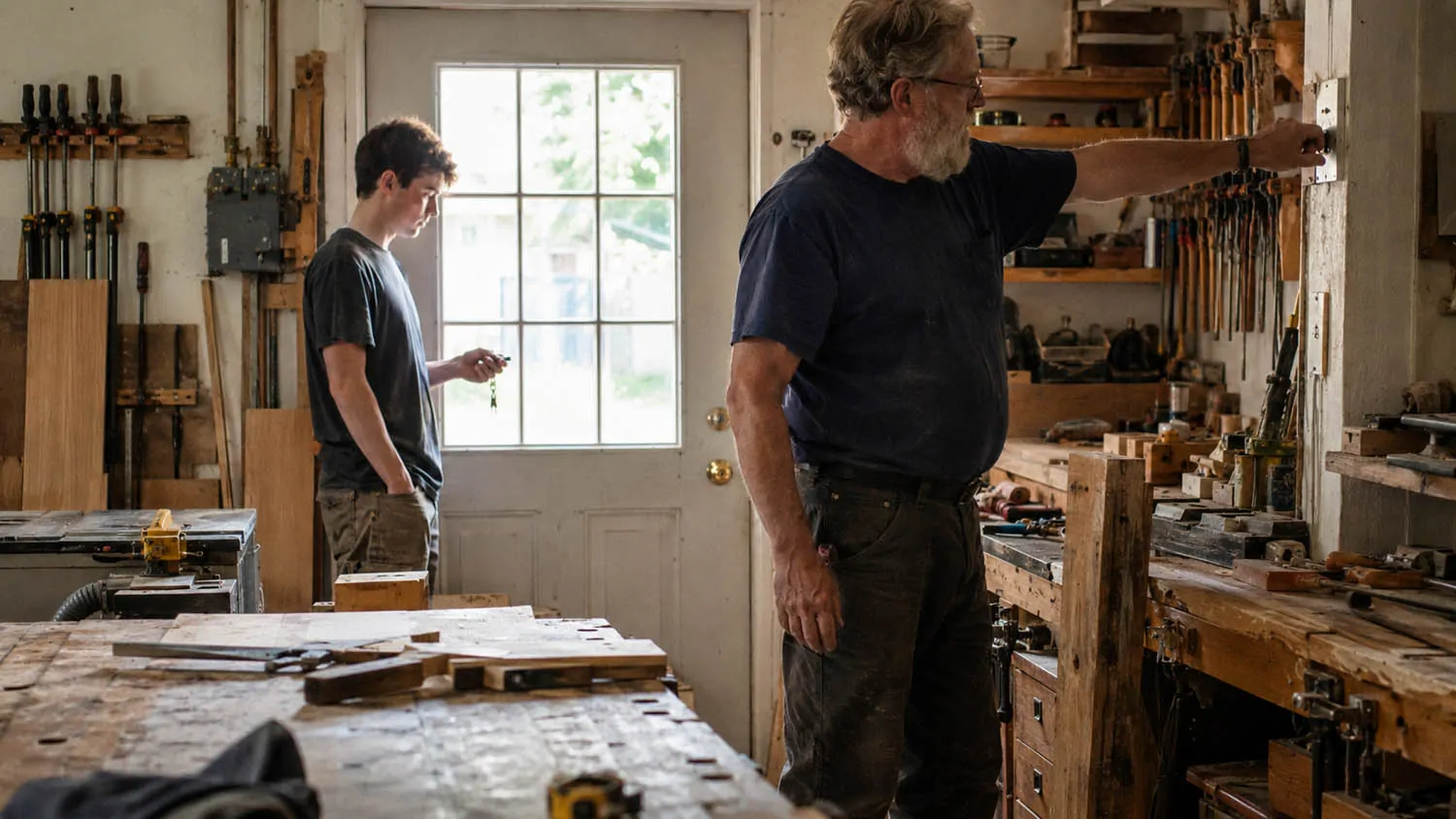
Near the end of the afternoon, the owner of a small woodworking shop begins closing for the day. The last customer has left. A radio plays near the front counter, and fine dust covers the floor after hours of cutting and sanding.
A sixteen-year-old who helps after school starts the routine he knows. He sweeps beneath the workbenches, hangs the clamps on the wall, checks the lids on the cans of finish, and takes a bucket of scraps to the bin outside. For months, he has worked under direction. The owner tells him what needs to be done, shows him how to do it, and checks the result.
When the shop is ready to close, the owner reaches into his pocket and hands him the key.
“Go ahead and lock up.”
The teenager pauses before taking it. The owner has never handed him the key before. Until now, every task has ended with someone else checking his work.
He walks to the back door, pulls it closed, and fits the key into the deadbolt. It sticks at first. He adjusts it, turns it again, and feels the bolt move into place. He pulls on the handle to make sure the door holds.
The owner has already turned away, shutting off the lights near the front. He does not inspect the lock or ask if the latch caught properly. He leaves that part to the teenager.
Sweeping the floor and returning tools fulfilled the owner’s instructions. At the locked door, the teenager has to judge the latch for himself. Left unsecured, the tools, materials, and finished pieces inside would be exposed overnight. Any failure would now be his.
By handing him the key, the owner joins responsibility to authority. Supervision ends at the threshold, and the security of the shop depends on what the young man does.
At first, a young worker follows instructions while someone older answers for the outcome. Then he is trusted with a tool, a room to close, a shift to run, or a task that affects others. Each handover enlarges the territory within which the worker’s judgment counts.
The key lets the teenager secure the shop, and the owner expects him to do it. He decides whether the latch has caught, and an open door in the morning would expose a mistake. Following instructions teaches discipline. Judgment develops through deciding, acting, and living with the result.
Boards, gardens, and paths record what people do. A poorly cut board cannot be returned to the lumber pile. Missed weeks in a garden show up in dry soil and weeds. Mud and brush close a neglected trail. Their condition shows the quality of the work done there.
Territory gives judgment somewhere to operate. A person can notice what is present, respond within limits, and see the consequence.
In adult life, the handover often stops as private obligations multiply. Households, children, debts, and careers demand constant decisions, and mistakes have consequences. Beyond the property line, authority narrows quickly.
A resident may pass the same neglected corner every day and still have no standing to improve it. A parent may know exactly where a crossing is dangerous and have no practical route to change it. A capable neighbor may be ready to keep a meeting room in order, prune a branch, or inspect a trail. Acting requires permission from officials or contractors who rarely visit the site.
At home, adults are expected to choose and pay for mistakes. In civic affairs, their assigned role is usually to fill out a form, attend a hearing, or wait on a work order decided elsewhere. Official invitations to get involved often lead back to a distant office.
Young people still face serious trials. They leave home and enter schools or workplaces where failure has consequences. Many later raise children, take on debt, support aging parents, meet professional demands, and endure loss. These experiences require discipline and teach limits.
In many older communities, such trials changed an adult’s public standing. Experience led to recognition as a master of a trade, trusted keyholder, elder, caretaker, or steward of a room or piece of land. The community recognized that experience by entrusting them with a workshop, a room, or a piece of land.
Today, people often return from those trials with no recognized civic role. A person may spend decades becoming capable and still find nowhere to put that capacity to use. The same adult can direct a construction crew on Monday and spend Saturday filing a ticket about a broken neighborhood step. Few institutions mark the point when years of work, parenthood, hardship, craft, and service have earned public trust. What those years have taught remains confined to private life.
So an adult may manage a household, navigate a demanding career, support aging parents, and accept serious financial risk while moving through the nearby streets as a spectator.
The limits appear in ordinary moments. A resident notices a broken step along a trail, an overgrown corner blocking a sightline, or a neglected patch of ground beside a neighborhood hall. The fix may be obvious. The resident still lacks recognized authority to act.
Taking a saw to the branch or a hammer to the step may cross a property line, violate a maintenance agreement, create a liability concern, or trigger permissions spread across several agencies. The resident reports the problem and waits.
The layout of many neighborhoods reinforces the lesson. Houses turn inward around garages and private yards. Management companies oversee common grounds. Covenants, service contracts, and online ticketing systems govern small decisions. The person beside the problem submits a ticket to a property manager or department that controls the response from elsewhere.
Repeated encounters teach a narrower habit of attention. Residents stop volunteering solutions when their word has no standing. They concentrate on the house, the job, the family schedule, and the private hobby, where they remain free to act.
This withdrawal is easy to mistake for indifference. Repeated refusals and delays have trained capable residents to leave public problems to whoever controls the property, the budget, or the work order.
Children notice the retreat long before they can explain it. When competence stays inside homes, offices, and specialized professions, young people have fewer chances to learn what grown people are for. Their daily view is filled with adults buying, working, rushing, arguing, and recovering behind closed doors.
A child may rarely encounter the neighbor who tends a common path, the craftsperson who mends a damaged chair, the teacher who guides a room with calm authority, or the local steward who checks the doors after everyone else has gone home.
Performance fills the gap because screens display it easily. On a screen, the loudest adults are entertaining, expressive, and always present. For children, the spectacle offers amusement and a thin picture of what growing older is for.
A child needs to see adults take responsibility for something beyond the household. The person who sets a boundary becomes more credible when the child also knows what that adult protects, maintains, or provides for others. The boundary has force because the child can see whether the adult returns when something breaks and makes it right for the people who depend on the place.
When such examples disappear, growing up can look like permanent supervision followed by private self-management. A different future becomes visible when children see older people trusted with a real part of the neighborhood.
Rebuilding that horizon requires rooms, paths, gardens, and other places where people have both responsibility and authority.
A neighborhood room can have a known steward who keeps the key, understands the building, and remains responsible for its condition. That keyholder can approve ordinary uses, call the plumber, unlock the door, and leave the tables and floor ready for the next group. Neighbors know whom to ask and who will still be there after an event ends.
A shared workshop can put young people beside craftspeople who use tools well, respect materials, and finish difficult work. The adult at the next bench corrects a bad cut, returns each tool, and sweeps the sawdust before turning out the lights. The next group enters a shop already in order.
Public paths, gardens, park edges, and creek corridors can have named local caretakers with defined responsibilities. They inspect damage early and handle small problems within agreed limits. They organize seasonal maintenance and contact the city when the damage requires public crews or money.
To make that possible, a civic institution must appoint the steward and define the territory. The role should state which repairs fall within the steward’s discretion and which require permission. A keyholder could then replace a loose hinge or clear a blocked sightline without filing a new request. The steward would earn public standing by returning after a failed fix and seeing the work through.
In these roles, a capable adult knows which room, path, or garden falls under their watch, and neighbors know whom to approach when it is neglected. Children can watch that adult notice a problem, act, and return later to inspect the site.
The key handed to the teenager opens the shop door. It also tells him that one part of the world now depends on his judgment.
A flourishing city gives children something worth growing toward and adults a real part of the world to answer for.
