
How a useful machine came to organize the places where we live.
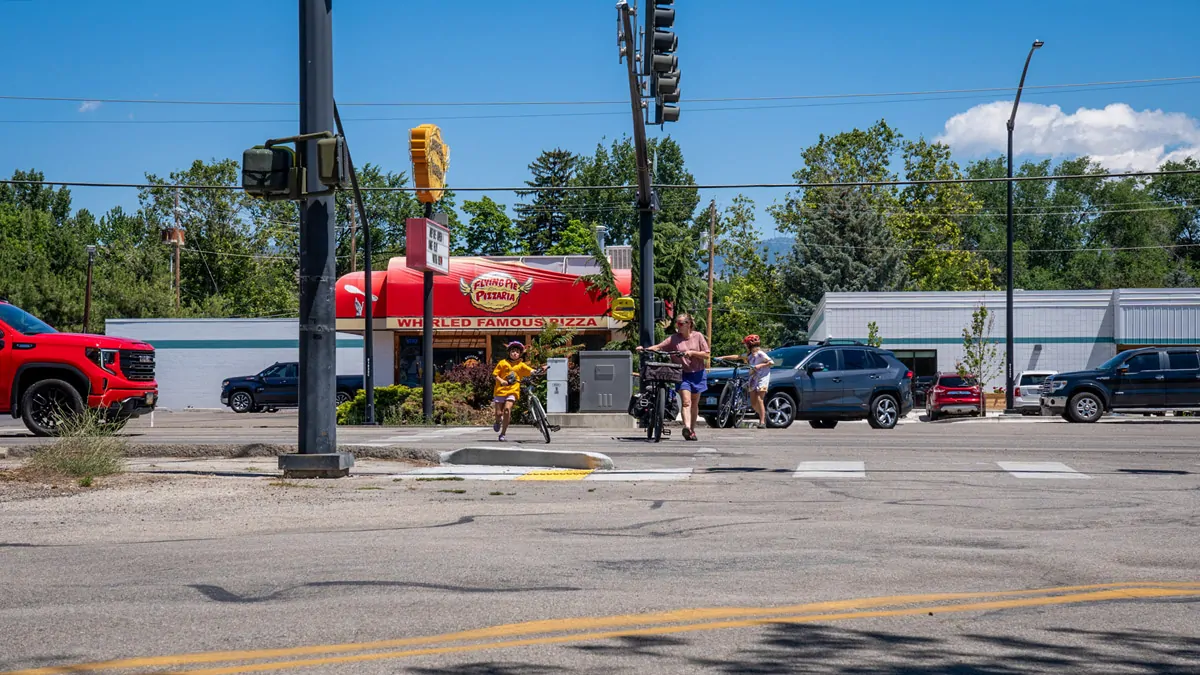
An ordinary bike ride out of downtown Boise in the late afternoon shows how the city divides its ground. Moving past the core commercial blocks, most of the outdoor surface is organized around driving. Travel lanes and turn pockets fill much of the street itself. Parking garages take up chunks of nearby blocks, and curb space holds more cars. Along the commercial corridors, storefronts sit behind wide parking lots, placing rows of parked cars between the sidewalk and the front door.
Further out, on residential streets, driveways cut across the sidewalk, double garage doors face the street, and vehicles line the curbs. Along the whole trip, almost everyone is inside: behind a windshield, inside a shop, working in an office, or resting behind a backyard fence. The common exterior of the city is arranged for vehicles in motion or vehicles at rest.
There was a reason cities made so much room for cars. A car makes long distances across a wide valley manageable, provides heat in January and air conditioning in July, carries groceries and tools, and gives people reliable control over their schedules. It makes a dispersed region workable.
The question that comes up from the saddle is how a tool for moving around came to dictate the shape of the places where people live.
A car takes up space even after it stops moving. At home, it needs a driveway and a garage. At a grocery store, office, or school, it needs a parking spot. Between those places, it needs travel lanes, turning space, and clear sightlines. Repeated across thousands of daily trips, those simple requirements reshape buildings as well as streets.
At home, many people now enter through the garage. In commercial areas, shops sit pushed back behind asphalt fields. Between neighborhoods, corridors widen to keep traffic moving, creating broad asphalt barriers between destinations that sit only a short distance apart. Storing cars at both ends of every trip expands the footprint of the whole valley. Buildings sit farther apart to make room for parking lots and access roads, stretching the distances between ordinary daily errands. What began as an accommodation for a useful tool gradually became the default pattern of the city.
For an adult with a car, that arrangement provides immense daily freedom. A car offers privacy, carrying capacity, and predictable access across the valley. In a spread-out city, driving lets people reach work, errands, and friends on their own timetable.
Change the vantage point to a twelve-year-old, and that same landscape produces an entirely different condition. When destinations are separated by fast arterials and deep parking lots, reaching many ordinary destinations requires an adult willing to drive. In the City of Boise’s 2025 Youth Roadmap, young residents and parents identified transportation as the biggest obstacle to reaching jobs, parks, libraries, and after-school activities. A simple test reveals how a street actually functions: would a parent let a twelve-year-old travel the route alone? When the answer is no, ordinary participation in the city turns into a series of chauffeured rides. On a calm local street, that independence can begin much closer to home: walking to a friend’s house, riding a scooter around the block, or biking somewhere without an adult beside them.
The same pattern appears at the other end of life. Research from the National Institute on Aging notes that giving up driving can feel like a loss of freedom and can raise fears about becoming dependent on others. A city built around driving concentrates independent mobility in a specific middle window of adulthood. Children wait for rides, licensed adults gain a much larger range of independent movement, and ordinary trips can become difficult again when driving is no longer easy. Distance and family habits matter too. The street outside can still widen or narrow the territory a person can reach on their own.
A wide roadway creates a boundary across the city without needing a fence. When a library, park, or corner store sits visible three hundred feet away across five lanes of fast traffic, the usable neighborhood ends at the curb. The street becomes a wall when the people beside it cannot safely cross into the life on the other side.
Anyone walking or riding a bike recognizes that tension. The body registers the exposure of a narrow sidewalk pinned against traffic, the long crossing distance, and the speed of passing vehicles. Transportation safety research confirms what people feel directly: crash severity rises sharply with speed, and on fast, multilane roads a marked crosswalk alone may not provide enough protection.
Boise and ACHD have started repairing some of these gaps. The pedestrian beacon and median refuge at Chinden Boulevard and 43rd Street, along with new multi-use paths and crossing signals on Fairview Avenue, show a deliberate effort to improve connections between neighborhoods and nearby destinations. They also point toward a larger standard: the route has to work continuously, including where it meets fast traffic.
Traffic engineering already recognizes that local streets and arterials do different jobs. Local streets are built around low speeds and access to the places along them; arterials are built to move traffic farther and faster. A street is a civic room: a place where storefronts, homes, shade trees, walking, and slow local movement share space. A road is a transportation utility, built to move people, goods, emergency vehicles, and commuters across distance.
Classifying these environments properly mirrors the way cities handle electricity. We route, bury, and insulate high-voltage power lines because useful energy still has to be handled safely around people. High-speed traffic deserves the same discipline. The higher the speed, mass, and volume of traffic, the stronger the protection required where people live, walk, and cross.
A quiet neighborhood street accommodates cars on terms set by front porches and people walking. A high-capacity arterial may require stronger buffers, protected crossings, or separated pathways where it cuts through a neighborhood. Transportation remains valuable because it connects people to places, leaving streets and public spaces intact as territory where people can actually live.
Seen from the saddle, the garage fronts, turn lanes, and parking fields along the ride look like what they are: historical choices. They reflect an era that reorganized the common exterior around the needs of a single machine.
Major corridors will always need to carry freight, emergency response, and commuters across the valley. The way space is divided outside is inherited design, and it can change as neighborhoods evolve.
Boise can preserve the mobility drivers rely on while keeping more of its streets usable for daily life. A child can ride to a park independently and an older resident can reach ordinary destinations safely, while the street still works as a place after the car passes through.
Cars gave us a larger world. The next step is to make the world outside them larger too.
