
A street is not just a street. It is a story we tell ourselves about what matters.
For a long time, the story we’ve told about Ustick Road is one of autonomy. It is a main arterial. A “flyby neighborhood,” as Winstead Park President Amanda Hundt calls it. A place where houses “feel intruded upon by the traffic,” protected by “sound fences and barrier trees.”
Ustick, like so many of our public spaces, is not a place for being. It is a “gray zone” designed for the flattened purpose of getting from Point A to Point B. We are “autonomous when we’re behind the wheel,” says City of Boise Program Manager Nicole Carr. We are isolated, disconnected, and on “autopilot.”
This is a system that has lost its pulse. When a system stagnates, dysfunction moves in. Amanda hears the “desperation” from residents on side streets, watching cars “fly through 35, 40 miles an hour,” ignoring the stop signs, the crosswalks, and the school zones.
This is the sound of a system serving its own inertia, not the people who inhabit it.
And then, for one day, we introduced a new rhythm.
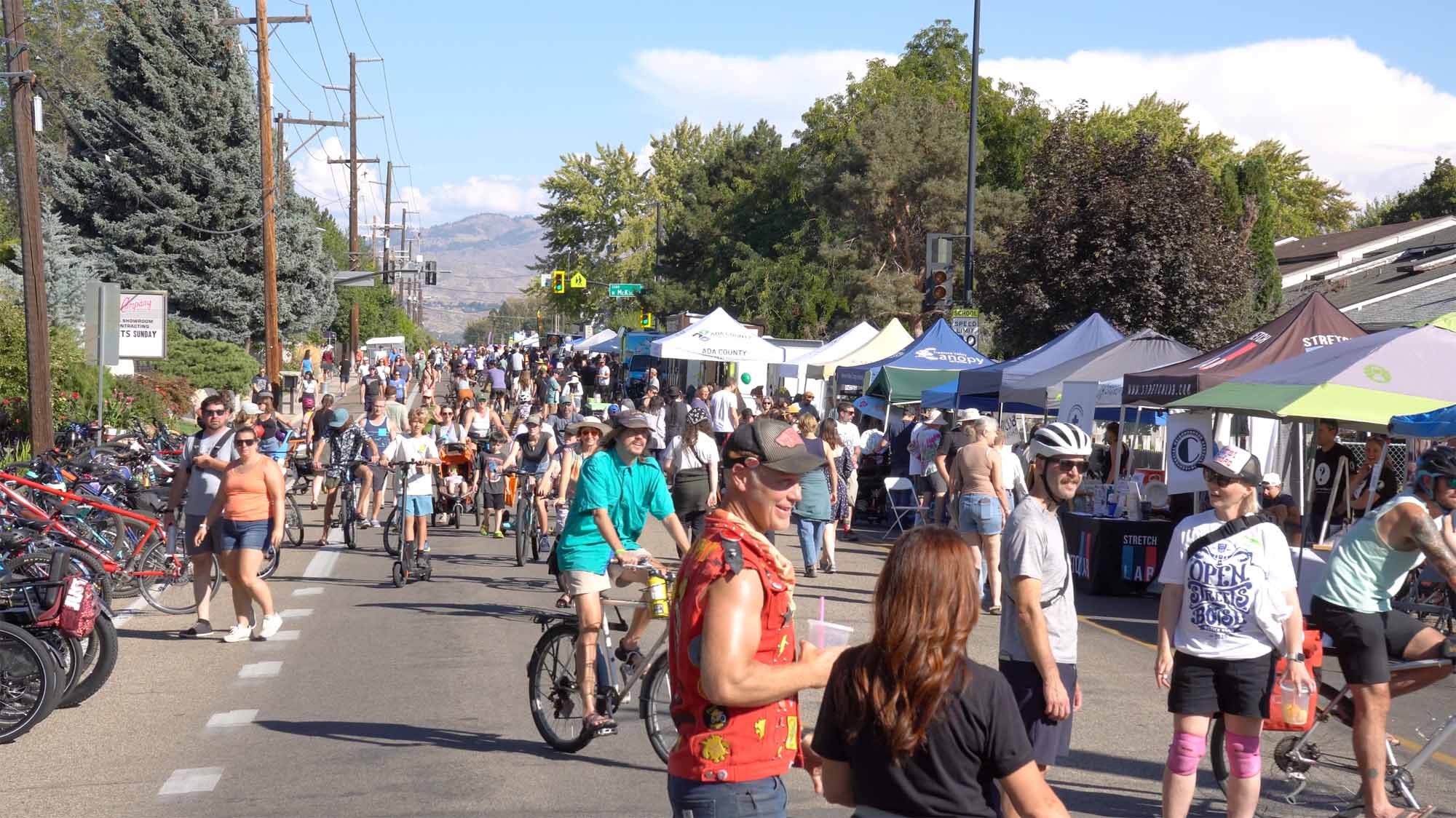
The idea of Open Streets is simple. It’s an act of civic imagination. It asks a question: What happens if we stop the stagnant system and create, for just a few hours, a new kind of space?
For organizers, the “discomfort and disruption” of closing a major road isn’t a bug; it’s the entire point. “The idea,” says Boise Bicycle Project’s Gillian Horn, “is to start a conversation and challenge our community to reimagine what that space feels like.”
It is an act of productive tension. An invitation.
First, there is silence. The “eerie anticipation,” as Gillian calls it. The “lack of street noise, for the first time ever,” as Amanda notes, is shocking. The ever-present rhythm of traffic—the heartbeat of the car—stops.
And in that quiet, a new heartbeat begins.
It begins, as Nicole remembers, with a drum set “plopped down in the middle of the roadway.” Soon, neighbors run home to grab guitars. A jam session erupts, organic and alive. Gillian watched as 500 cyclists crested the hill together, a “slow build to this really awesome crescendo.” The Idaho Shaolin Center, a business on Ustick, held a martial arts demo in the middle of the street.
This is what happens when you create a space for life to emerge. The generative, creative pulse of community rushes in to fill the void.
The most potent symbol of this transformation is not the large crowd. It is the small detail. Gillian watched a little girl, who lived directly on Ustick, come out with her dad. “She jumped on her purple tricycle and rode straight out into the middle of Ustick Road. Didn’t even look back.”
In that moment, the street, for the first time in her life, whispered to her about her own potential—her potential to be a child, to be safe, to play. And she recognized it, instantly.
This is how a simple space becomes a sacred one. It is the act of turning a piece of infrastructure back into a Place. It is the difference, as Gillian notes, between a commute that is “a to-do list” and one that is “a whole experience.”
When the barriers come down, the cars return. The old story resumes. But, as Nicole says, the memory stays. The space is changed because the people are changed.
“Maybe people won’t see Ustick as a commuter street anymore,” Amanda hopes. “Maybe they’ll see it as a destination.”
This is the true work. The event is not the goal. The event is the signal. It is the generative work that proves a better world is possible. It gives neighbors the felt experience—not just a proposition—to go to ACHD and demand something better than just “car-based infrastructure.”
It is the audacity, as Amanda says, of “a bunch of people [who] came together and thought it would be cool to shut a whole street down.”
Open Streets doesn’t ask us to close Ustick forever. It asks us a simpler, more profound question:
What if our streets felt this safe—this alive—every single day?
That conversation, as Gillian notes, isn’t just for the organizers to lead. They “hope to empower the neighborhood… to drive that conversation from then on.”
It is an invitation to every neighborhood, to every citizen.
It is an invitation to build.
