
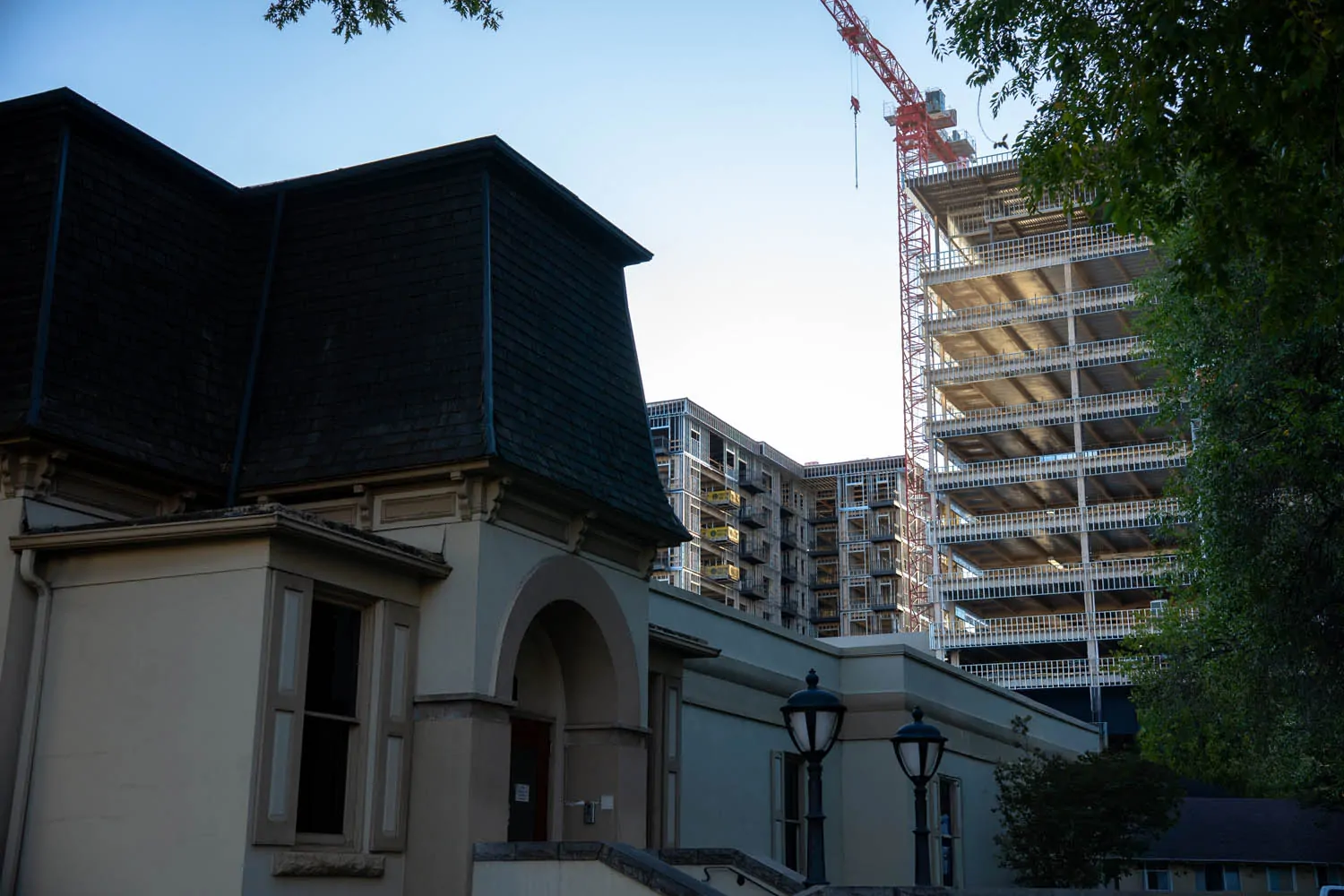
How we build reflects what we value. If we don’t like the story our city is telling, we are the only ones who can write a new one.
The Sound Through the Walls
Listen.
Can you hear it? The neighbor’s music, muffled but insistent. The footsteps overhead, a dull rhythm against your ceiling. The bass from a car stereo bleeding through the window, an unwanted pulse in your living room.
For too many Boiseans, this is the soundscape of home. Not the gentle hum of belonging, but the low-grade, constant static of intrusion. It’s the sonic expression of spaces built without care—thin walls, poor insulation, layouts that treat privacy not as a human necessity, but as a luxury item.
This isn’t just an inconvenience. It’s a violation. It’s the feeling of being perpetually exposed, unable to find true rest or sanctuary. It’s the slow erosion of dignity that comes from living in a box designed not for human flourishing, but for maximum efficiency on a spreadsheet. This is not “home” in the sense our souls crave. It is habitation without sanctity. It is the chaotic intimacy of forced proximity, stripped of the grace of real connection.
But this sickness isn’t confined to apartment complexes. The modern single-family home, often sold as the antidote, presents the other side of the same desacralized coin. Behind the facade of private yards and two-car garages often lies a profound isolation. A home becomes an island in a sea of asphalt, reachable only by car, disconnected from the natural rhythms of community. It offers privacy, perhaps, but at the cost of connection. It, too, is often a space devoid of a true center, a fragment of a world built for commuting, not for communion.
We have been offered two false choices: sterile isolation or chaotic intrusion. Neither nourishes the human spirit. Both are symptoms of a deeper cultural failure, a loss of the very idea of sacred space.
A Confession in Brick and Mortar
How we build is a reflection of ourselves. Our city is not an accident. It is a physical confession of our actual values, not the ones we claim in mission statements or community plans.
What do our newest apartment buildings confess? Too often, they confess that short-term profit holds more weight than the long-term cultural value of human dignity. They confess that tenants are units of revenue before they are neighbors, that the sonic and psychological wellbeing of residents is secondary to the speed and cheapness of construction. They confess a system that incentivizes cutting corners, a market logic that prioritizes the financial instrument over the human habitat.
What do our streets confess? Sprawling arterials flanked by strip malls confess that we value the convenience of the automobile over the intricate, fragile needs of human community. They confess that we prioritize the movement of inanimate, noisy, dangerous machines over the safety and connection of the sensitive, sentient creatures who are supposed to be the reason for the city.
What does our endless sprawl confess? It confesses a preference for private isolation over the difficult, necessary work of building genuine public community. It confesses a desire to buffer ourselves from difference, rather than to weave diversity into a coherent whole.
This is the logic of extraction, not creation. It’s a pattern that emerges when systems are designed for immediate gain, ignoring the downstream consequences for the human soul and the civic spirit. It’s a confession written in drywall and asphalt, revealing a culture that has lost its connection to the deep, nourishing patterns of place.
The Echo of a Better Story
But we know this is wrong. We feel it in our bones. The proof isn’t just in our frustration; it’s in the places we instinctively cherish, the parts of our city that still resonate with something deeper.
Why do we designate historic districts? Why do we spend tax dollars preserving the North End, Harrison Boulevard, or the East End? Why do these neighborhoods consistently hold the highest value, both financially and culturally?
Because they were built differently. They were built not primarily as financial instruments, but as places. They were built by pioneers who, consciously or not, were engaged in what the historian Mircea Eliade called “founding a world.” They weren’t just erecting structures; they were establishing a cosmos, a centered, human-scaled environment against the backdrop of the vast, untamed landscape.
These places feel different because they are different. They possess what Boise Rising calls strong “Membranes”—the porches, the sidewalks, the corner stores, the tree-lined streets—that masterfully mediate between the private realm of the home and the shared life of the community. They balance solitude and connection. They confess a different, richer story about what a city can be. They were built with vision and spirit, and that energy remains palpable today. They remind us that building can be an act not just of construction, but of consecration.
The Unifying Project: Building the Third Way
We cannot simply replicate the past. Our task is not nostalgia. It is to learn from the echoes of that better story and build a new sacred for our own complex time.
The vast majority of Boiseans—whether renting or owning, young or old, newcomer or native—feel the lack. They feel the “ontological thirst” for a world that feels real, for a home that feels like home, for a community that feels connected. They sense, deep down, that the spaces we inhabit are failing us, but often lack the language or the framework to articulate why.
This is the unifying project Boise Rising seeks to name and advance. We must demand, design, and build a Third Way: housing and neighborhoods that reject the false choice between isolation and intrusion. We need what is often called the “Missing Middle”—housing types that bridge single-family homes and large apartment blocks—but infused with a conscious intention to create sacred space.
Imagine neighborhoods designed around shared courtyards, where children can play safely and neighbors can gather naturally. Imagine apartment buildings with walls thick enough for silence, with layouts that honor the natural, intuitive hierarchy of privacy that makes a dwelling feel like home—from the shared porch meant for neighbors, to the living room reserved for friends, to the quiet sanctity of the bedroom. Imagine homes designed for psychological diversity, offering both street-facing vibrancy for extroverts and quiet, inner-garden refuge for introverts and sensitive souls—the “canaries in the coal mine” whose suffering under current conditions signals a toxicity that affects us all. Imagine streets designed as beautiful, human-scaled outdoor rooms, not just corridors for cars.
This is not a utopian dream. It is a practical, achievable vision rooted in timeless principles of human wellbeing and sustainable design. It requires us to challenge the logic of extraction and embrace the work of “Productive Striving”—building for long-term cultural value, not just short-term profit.
This invitation extends beyond architects and developers. It’s a call to every citizen. To the teacher longing for a quiet space to recharge after a demanding day. To the firefighter who navigates streets designed against human safety. To the lawyer or doctor who feels the city’s soul eroding despite its economic growth. To the nurse who sees the physical and mental toll of stressful environments.
The early pioneers founded their world here. They built a city that reflected their values. Now, it is our turn. We must become the pioneers of a new sacred in Boise. We must assume the responsibility to build a city that confesses not our anxieties and compromises, but our highest aspirations for dignity, connection, and beauty.
The work begins by recognizing the truth: our buildings are our confessions. If we desire a different future, we must start building it now, brick by thoughtful brick.
