
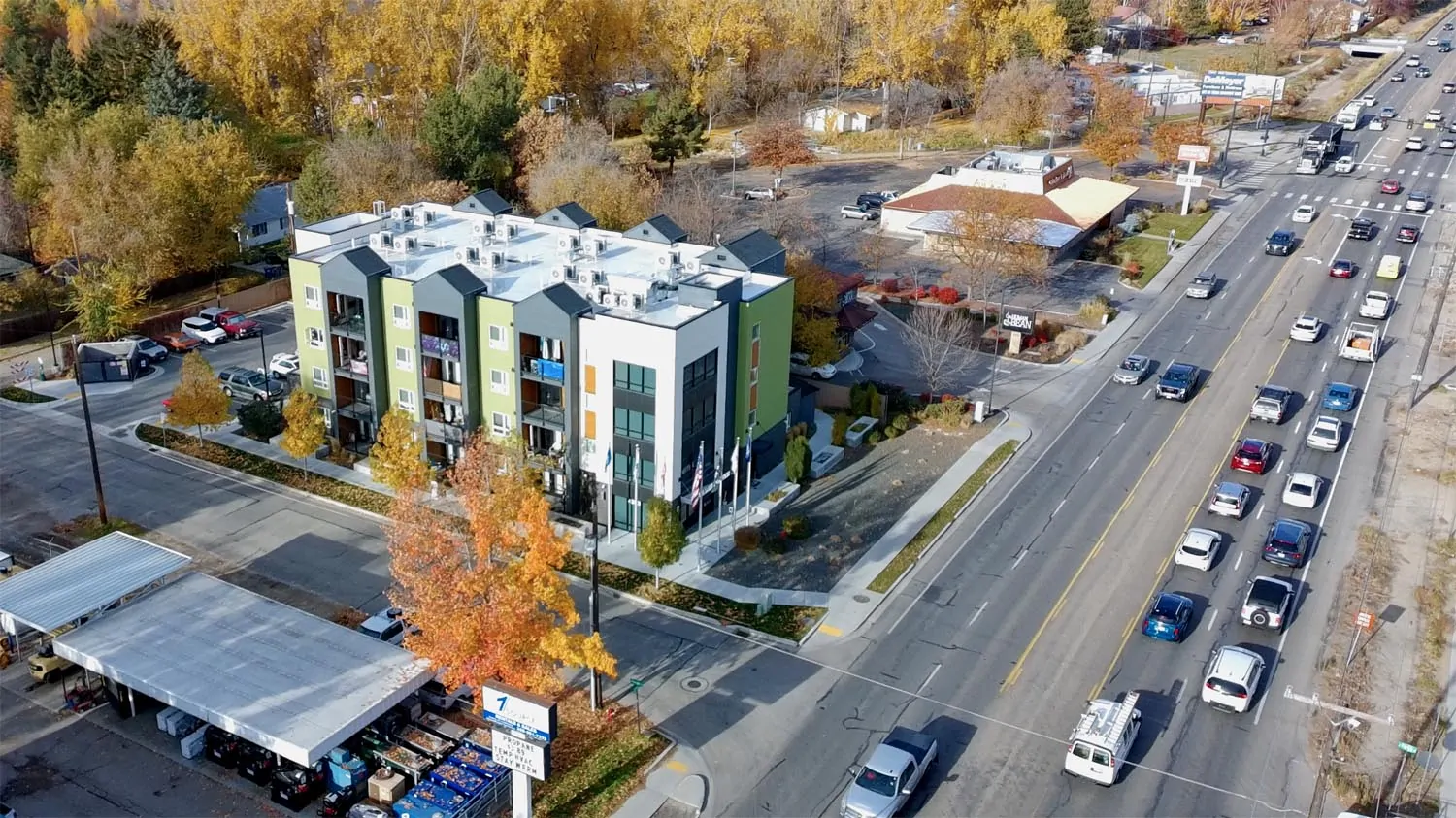
Walk into the middle floor of a modern apartment complex. The finishes may be polished, the location ideal, and the amenities generous. Yet for many, there is a distinct, low-grade tension in the air.
It feels like compression. It is the subtle sense of being suspended—cut off from the ground below and capped by the floor above. Despite the high ceilings, the space feels less like a center and more like a container.
We often blame ourselves for this feeling. We assume we are just restless, or difficult.
But the friction is rarely the person. The friction is the geometry.
The Center of the World
For thousands of years, builders understood that a home performs a specific psychological function. It acts as an axis mundi—a center of the world.
Human beings are upright creatures. To feel fully oriented, we possess a biological need for vertical sovereignty. We seek a direct connection to the stability of the earth and an opening to the sky. When a dwelling provides this vertical line, the inhabitant feels anchored. The home becomes a fixed point in a chaotic world.
This explains why the same person who sleeps soundly in a narrow townhouse might feel unmoored in a spacious unit stacked halfway up a monolithic block. The townhouse respects the vertical axis; the stack dissolves it.
Storage vs. Sanctuary
In our rush to solve the housing crisis, we have confused “density” with “stacking.”
We have defaulted to a filing-cabinet model of development. We stack units like inventory, prioritizing efficiency over orientation.

Human beings are adaptable. Many residents navigate these spaces without issue, prioritizing location or community over the geometry of the home. For them, the trade-off is worth it.
But for a significant number of people, this loss of vertical sovereignty functions as a persistent stressor. When you are sandwiched between floors, living in someone else’s ceiling and on someone else’s roof, the nervous system often remains in a state of vigilance. The home requires endurance rather than offering restoration.
Density with Dignity
We are often presented with a false choice between the sprawling single-family home and the monolithic apartment block.
But a third option exists. It is the way our ancestors built vibrant cities for centuries.

Townhomes, row houses, and cottage courts offer high density without severing the vertical connection. In these forms, the land is sliced vertically rather than horizontally. A resident walks through their own front door at street level and rises to a window that opens to the sky.
This simple shift in geometry preserves the dignity of the axis mundi. It allows for the efficiency of urban living while respecting the human need for orientation.
A New Standard
We must stop measuring housing success solely by the number of units created. A unit is a spreadsheet term; a home is a human one.
Boise has a choice. We can continue to build structures that ask residents to adapt to the needs of the building, or we can build structures adapted to the needs of the human inhabitant.
This means prioritizing forms that preserve vertical sovereignty. It means designing neighborhoods where the default is not the stack, but the row.
The city we build determines the citizens we become. If we want a city of grounded, resilient people, we must build homes that act as anchors, not cages.
