
The Expedition
In May of 1920, Robert Limbert set out on an expedition that most sensible people in Boise considered a form of madness.
While the rest of the frontier was busy measuring the Idaho wilderness in board-feet of timber or ounces of gold, Limbert was engaged in the slow, difficult work of immersion. He and a companion plunged into the jagged, volcanic wasteland of central Idaho, drawn in part by the vast southern stretch the maps still left blank. They spent weeks dragging heavy packs across the sharp lava crust of the “Valley of the Moon,” treating what Limbert called the “Unfinished Work” of the desert as a reality to be respected rather than a commodity to be harvested.
Limbert was a taxidermist and a promoter, but at his core, he was a builder. A few years later, he would help craft the Redfish Lake Lodge, a place that remains a testament to his specific vision. He viewed a building or a trail as a physical anchor, a way to graft a human being into the specific character of the land. To Limbert, the Idaho landscape was a partnership that required full attention, physical responsibility, and a long-term commitment.
We still claim to value exactly what Limbert found out there. We name schools after explorers, we hang photos of that same jagged wilderness in our offices, and we tell our children that a life well-lived is about courage, meaning, and a deep connection to the world around them.
But a strange contradiction has emerged in the Treasure Valley over the last fifty years. While our hearts still long for that rooted, expeditionary path, our hands have been busy building a landscape that makes that kind of life almost impossible to find. We have created a world where the spirit of the explorer is honored in our slogans, but systematically squeezed out of our streets.
The Great Substitution
The reason this gap between our ideals and our environment feels so wide is that we have spent the last fifty years performing a wholesale substitution. We have confused two fundamentally different ways of existing in the world.
In 1976, the psychologist and philosopher Erich Fromm published a slim, haunting book titled To Have or to Be? In it, he diagnosed the exact hollowness that many of us feel when we look at our modern landscapes. Fromm argued that most of us are caught between two competing modes of existence.
The first is the Mode of Having. This is the language of the transaction. In this state, our primary relationship to the world is one of possession, control, and extraction. When we are in the Having mode, we view our surroundings as a collection of assets to be managed or hurdles to be cleared. In this mode, a neighborhood is viewed as a collection of properties to be owned rather than a place to be inhabited. A journey is reduced to a commute to be completed, while the focus is always elsewhere. The purpose is always the result: the total at the bottom of the closing statement or the speed with which we can move through a space. We end up managing our days instead of actually inhabiting them.
Contrast this with the Mode of Being. This is the state Robert Limbert entered as he met the Idaho desert on the raw terms of his own survival. This is the language of participation. To be in this mode is to show up with your whole self; to apply craft to a task, to listen deeply to a neighbor, or to take responsibility for a shared space. While the Having mode is about what you can acquire from the world, the Being mode is about how you are transformed by your encounter with it. It is the difference between possessing a map and actually walking the terrain.
The tragedy of the modern world is that we still use the language of Being to describe our goals, but we have built a physical world designed entirely for Having. We tell ourselves that we moved here for the “lifestyle” (a Being-word if there ever was one) but we find ourselves trapped in a world built for the efficient movement and storage of commodities.
A warehouse is a genuine miracle of modern engineering. It is a space of total order, designed to ensure that millions of objects move with perfect predictability and zero friction. In that specific context, the logic is flawless. It’s a system optimized for the storage of value, the security of inventory, and the relentless throughput of capital. It does exactly what it was designed to do: it manages a world of things.
The crisis began when we allowed that same logistical blueprint to become the default architecture for our civic lives. We moved from managing objects to managing our own existence with that same cold efficiency. When this logic is applied to a place like Boise, the results are unmistakable. We find ourselves living in residential pods designed for the storage of labor, navigating corridors built only for the speed of movement, and conducting our daily lives in transaction fields that prioritize the clearance of a barcode over the depth of a human encounter.
This logistical order is flawlessly suited to the storage of an asset, yet it remains a suffocating habitat for a person. We require an arena: a physical environment that acknowledges our capacity for agency and our need to be seen by our neighbors. It is in the arena that we move beyond the role of a managed unit and re-enter the world as citizens.
We have poured our collective genius into refining the warehouse, optimizing its speed and smoothing its edges, only to find that our most vital human capacities require a different kind of soil to take root. We are attempting to grow a meaningful life inside a container designed only for storage, and the result is a systemic hollowness that no amount of efficiency can ever hope to fill.
The Logistical Grid
The logistical grid is the physical pattern of our daily existence. It is the network of roads, property lines, and administrative boundaries that organizes the Treasure Valley with the cold precision of a distribution center. These structures are the physical expression of this transactional mindset: the concrete and asphalt reality of a world optimized for the movement and storage of things. Every curb and fence line serves as a literal marker for a life built around possession and throughput.
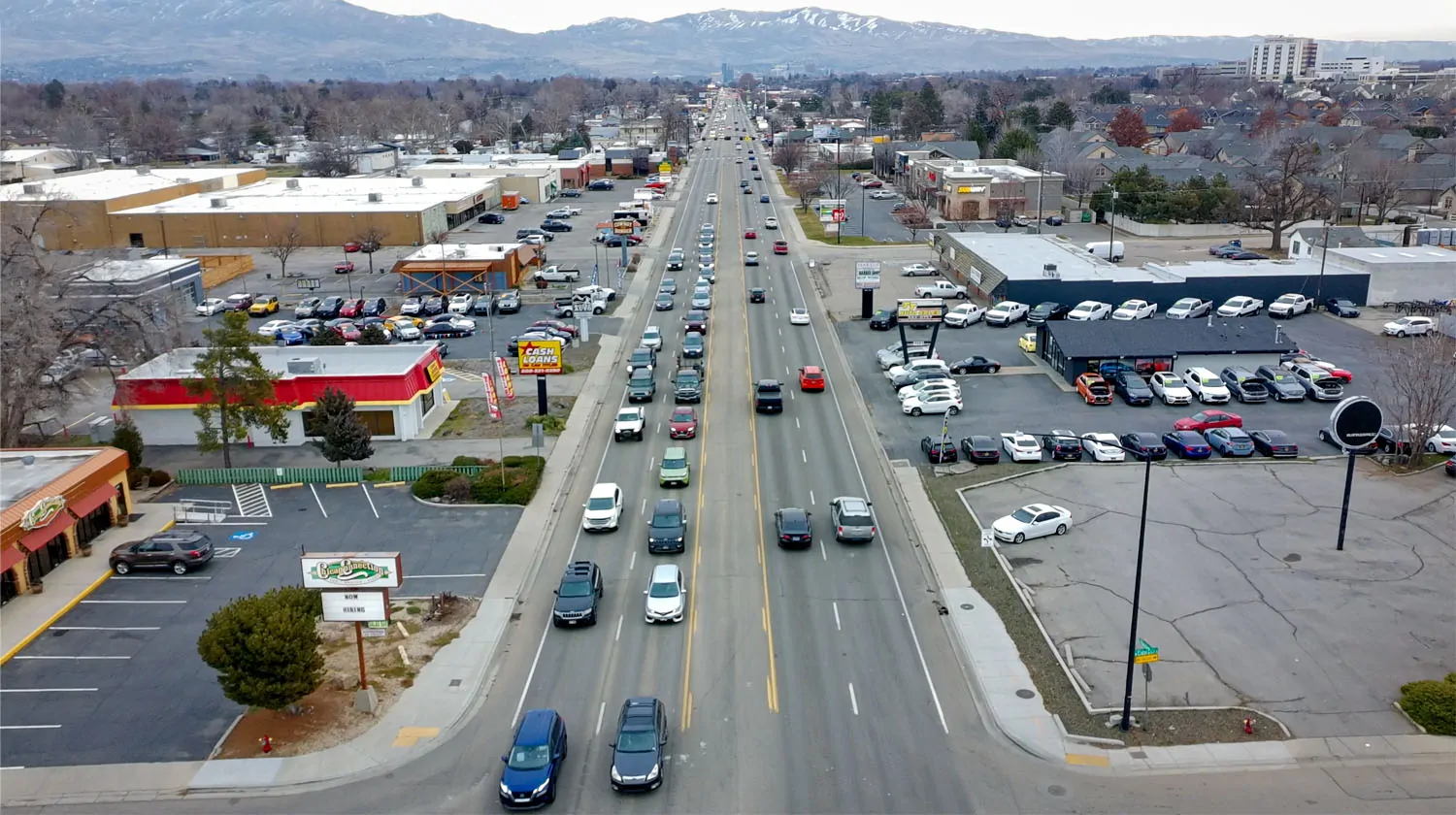
Consider the modern arterial road. In a world built for participation, a street is a place of encounter. It allows for presence, where a person might walk to meet a friend for coffee or notice the changing light on the Boise Front. But our dominant architecture treats the road as a pipe designed for the relentless throughput of vehicles. Its only purpose is instrumental; it exists to extract a person from one point and deposit them at another as quickly as possible. When a road is designed solely for the speed of movement, it makes the act of simple inhabitation—the ability to stop, to look, or to linger—physically dangerous. You cannot exist on a stroad; you can only navigate it.
This same logic has crept into the very places where we sleep. The modern house has increasingly become a sealed financial asset: a high-performance pod designed for storage and display. We speak of our homes in the language of possession: their square footage, their resale value, their return on investment. When a house is primarily an asset to be managed, it ceases to be a sanctuary for transformation. A home should be a place where the slow work of raising a family or the quiet focus of a hobby can take root. Instead, we have built houses that function like high-end storage units for labor, sealed off from the neighborhood and optimized for a lifestyle of managed consumption.
Even our civic life has been flattened into a logistical exercise. When we gather for a public meeting, the environment is rarely structured for collective judgment or shared responsibility. Instead, it is a procedural checklist, a series of administrative hurdles designed for liability management. The goal of the modern public process is often control rather than participation. We have traded the messy, transformative work of civic encounter for a sterile system of throughput, where the primary objective is to move a project through a committee without friction.
In each of these examples, the physical environment is training us. It is telling us that our role is to possess, to consume, and to move. It is teaching us that presence is a luxury and that participation is a liability. We have built a world that makes it incredibly easy to accumulate the assets, the coordinates, and the transactions of a life, while making it debilitating to actually inhabit one.
The Surface Fix
We are not blind to the hollowness of the logistical grid. We feel the friction of this arrangement every day, and our natural instinct is to try and fix it. However, because we are still operating within a transactional mindset, our solutions often take the form of surface-level additions. We attempt to solve a crisis of disconnection by adding more art, more branding, and more professionalized placemaking.
This is the point where the environment becomes deceptive. We apply vibrant murals to the dead walls of windowless buildings. We place public art in the middle of hostile, car-dominated intersections. We launch expensive branding campaigns to give a soul to neighborhoods that lack a physical center.
There is a profound difference between art that emerges from a community’s deep connection to a place, and art that is airlifted in to disguise a failure of urban design. When beauty is merely applied to the surface of a dead streetscape, it risks becoming a higher form of litter. It asks nothing of the citizen and offers no real anchor; it simply provides a momentary distraction from the logistical reality underneath.
We have spent years decorating these corridors in the hopes that we might eventually mistake them for a home. But a slogan cannot redeem a dead block, and a ritual cannot survive in an environment that is structurally hostile to it. To move beyond this betrayal, we have to stop applying cosmetic fixes and start rebuilding the arenas where beauty is actually allowed to happen.
The Biological Tax
The chronic depletion of modern life is often framed as a personal failure. A lack of discipline or a poorly managed schedule. In reality, this fatigue is a biological tax levied by our environment. We are tired because we are attempting to live lives of being inside a substrate designed exclusively for having, a task that requires a constant and heroic exertion of willpower.
In a world built for participation, the environment does much of the heavy lifting. A walkable street or a coherent civic square provides passive replenishment; it offers the sights, sounds, and social cues that allow the human nervous system to regulate. In these spaces, being is the default state. But the logistical grid offers no such support. It is a sterile landscape that views your presence as a friction and your attention as a commodity to be harvested.
Consequently, every attempt to simply be in the modern valley becomes a solo expedition. If you want to experience reverence, you must seek it out in spite of your surroundings. If you want to build a deep connection with a neighbor, you must create the space for it against the structural friction of the warehouse. The environment provides the how (the logistics, the speed, the access) but leaves the why entirely up to the individual.
We are biologically overspent because our habitat is constantly training us to manage, to optimize, and to consume. This is a high-cortisol existence. We have spent fifty years perfecting a world for the throughput of things, and in doing so, we have created a habitat that requires us to supply 100% of our own meaning out of our own limited energy reserves. We are drained because we are living in a world that refuses to help us live.
Building the Arena
To move forward, we must restore the proper hierarchy of human life. The logistical achievements of the last century—our wealth, our safety, and our capacity for throughput—serve as the essential foundation of a good life. They are the stage upon which the real performance of human existence occurs.
The mission of Boise Rising is to build the civic foundations that restore meaning, coherence, and beauty to our world. These foundations reside in every corner of our shared environment: the schools where our children are formed, the clinics where we face our vulnerabilities, and the industrial yards where we perform our labor. We see the entire city, from its hidden utility networks to the prominent landmarks and grand streets that give the city its shape, as a single, interconnected arena for participation. Every system we build must invite us to inhabit our reality with reverence and responsibility.
This means designing our libraries as steady anchors for our ritual life, our power substations as contributors to our visual order, and our water systems as reflections of our ecological intelligence. Whether we are shaping the character of an industrial freight depot or the quiet privacy of a senior housing courtyard, we are calling for an environment that demands judgment and responsibility rather than just administrative compliance. We want to design a world where participation is no longer a heroic act of willpower, but the natural rhythm of the day.
By building a world where the entirety of our infrastructure sustains our capacity for love, craft, and reverence, we make meaning easier to inhabit. We are building a city that is as deep as it is wide; a place where the miracle of our material success finally serves the grandeur of our human existence. This is how we build a home that can actually hold us.
The Long Haul
Robert Limbert’s expedition into the “Unfinished Work” was an act of profound participation. He emerged from that jagged, volcanic wasteland with the understanding that a builder’s true task is to graft human life into the specific character of the land. He built for the long haul, creating anchors like the Redfish Lake Lodge that still support the weight of our collective memory today.
Like Limbert, we are building for the long haul. A civilization cannot remain healthy when its highest moral language speaks of courage and connection, but its daily environment is built only for storage and speed. We are committed to the generational task of building civic foundations that can actually hold the complexity of a human life. We are creating a place where the environment finally reflects the grandeur of the people who inhabit it.
It is time to move beyond the warehouse. It is time to build the arena.
