
The Surveyor’s Line
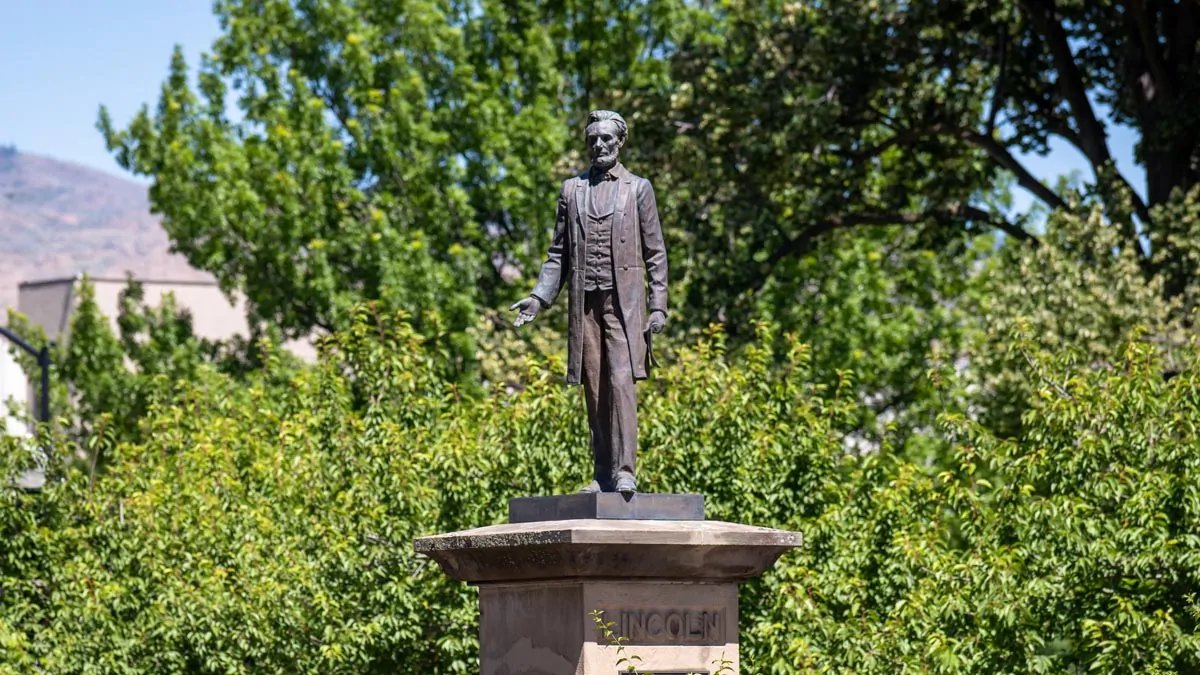
On the Capitol Mall in Boise, a bronze statue of Abraham Lincoln stands near the center of Idaho’s civic life. The main inscription tells the public story: Lincoln the president, Lincoln the leader who preserved the Union, Lincoln the man who created Idaho Territory.
But a smaller marker rests at his feet. Set into the ground is a surveying benchmark honoring a lesser-known part of his life: “Abraham Lincoln Land Surveyor 1834–1836.” The detail is easy to miss. It may also be the most revealing doorway into the city we inherited.
Before the architect, the builder, the developer, or the homeowner, there is the surveyor. The surveyor measures the land, draws the lines, and makes the ground legible to law, taxation, ownership, finance, and exchange. This practical work sets the terms for everything that follows.
Surveying gives land a civic grammar. A continuous landscape becomes a set of measured units. Territory becomes property. The shared field becomes a map of parcels, each with its own boundary, title, value, and owner.
That transformation made much of modern civic life possible. Clear property lines allowed homes to be built, investments to be protected, taxes to be collected, and disputes to be settled through law rather than force. The grid brought order to expansion. It gave a growing society a structure it could understand and govern.
But every useful abstraction leaves something out. The parcel is precise about boundary lines, but it says little about the relationships between them. It can tell us where one property ends and another begins, but it cannot tell us what kind of shared world those properties are supposed to form together.
The trouble begins when a tool designed to clarify ownership becomes the default way a city understands itself. When the smallest unit of possession becomes the primary unit of imagination, the city begins to fracture before a single wall is built. Land may still be owned, exchanged, improved, and developed. But the deeper question remains unanswered: what kind of place are these parcels supposed to become together?
The Great Spatial Mismatch
The geometry of the plat map eventually turns into the friction of daily life. When a city begins to feel fragmented or tense, the problem is usually described as cultural. People are said to want incompatible things. Some prefer acreage, distance, and privacy. Others prefer density, intensity, and the constant activity of the urban core.
Those preferences exist, but they do not explain the frustration of the broad middle. Many people move closer to the center of a city because they are looking for balance: proximity without overwhelm, connection without exposure, privacy without isolation, and daily access to places that feel alive. They are looking for a human-scaled middle, where ordinary life can be both private and shared.
In Boise, that search often leads to the historic grid neighborhoods around downtown. Today, these tree-lined blocks are treated as part of the city’s urban core. Historically, many of them were built as early streetcar suburbs: close enough to remain connected to downtown, but organized around quieter residential parcels and private household life.
As Boise expanded outward, these older neighborhoods were absorbed into the cultural idea of the core. Their location changed in meaning, but their underlying geometry did not fully change with it.
The city now asks many residents seeking community to live inside a pattern that still begins with the isolated lot. The address may feel urban, but the civic structure remains parcel-first. The individual property is clearly defined, while the shared interior of the block or neighborhood is often weak, accidental, or missing.
The mismatch shows up in the body. In a denser environment, proximity without shared structure often becomes exposure. People may live close together, but without thresholds, acoustic dignity, courtyards, porches, shared rooms, or other gradual boundaries, closeness becomes something to manage rather than something that naturally supports belonging.
The pattern crosses housing types. A single-family lot can make private life defensive in one way; a poorly designed apartment building can make shared walls and common edges feel exposed in another. People may move inward looking for connection, then find themselves retreating behind closed doors to recover from the very proximity they hoped would enrich their lives.
The mismatch sharpens when dense housing is placed inside landscapes designed for separation. The modern apartment complex dropped into suburban sprawl combines two failures at once: the isolation of a centerless environment and the sensory exposure of housing designed primarily around unit efficiency. Residents live near one another without being held inside a coherent place.
Community requires more than proximity. A neighborhood needs a geometry capable of holding both privacy and encounter. Without that structure, living near other people can begin to feel less like an asset and more like a burden.
The Neighbor as an Adjacent Jurisdiction
When proximity begins to feel like a burden, behavior adapts to the strain. The mind learns the spatial pattern it inhabits. In a city organized around the atomized lot, the property line becomes the most legible boundary between private life and the surrounding world. The fence becomes the primary membrane.
That arrangement changes how neighbors encounter one another. A person living next door is no longer encountered first as a co-inhabitant of a shared place. They begin to appear as an adjacent jurisdiction.
Without a shared civic interior to soften proximity, ordinary signs of life can become sources of tension. A barking dog, an unkempt yard, a late-night conversation, a bright light, a loud engine, or a renovation project can feel like an invasion of private space. A single incident may trigger the tension, but the block has already made that tension harder to absorb. There are few relational buffers between private sanctuary and public exposure.
So when friction appears, the response often moves quickly from relationship to procedure. A conversation across the fence gives way to code enforcement calls, homeowners’ association warnings, anonymous complaints, zoning objections, and public hearings.
The spatial order gives residents limited tools. With little shared ground to absorb tension, ordinary friction hardens into defense. The neighborhood starts to operate as a set of small borders instead of a common field of life.
A healthy city gives boundaries a humane hierarchy. The home holds privacy, acoustic dignity, and quiet. The block provides structure. The street supports safe and functional public life. The neighborhood offers a center, a threshold, and shared patterns of return.
When the property line is the strongest boundary a neighborhood possesses, private life grows more defensive and shared life weakens. The property may be secure, while the space between properties has little structure.
When Places Can No Longer Hold Stories
Parcel-first defensiveness eventually moves beyond private life and begins to shape culture. A fragmented physical world makes it harder for a city to sustain a shared story.
A city cannot patch that fracture with civic slogans or branding campaigns. A shared story needs continuity, familiar reference points, repeated encounter, and physical settings where memory can gather over time.
A city tells its story through its physical form. Landmarks hold the horizon. Daily routes become familiar through use. Thresholds mark arrival. Public rooms, neighborhood centers, and recurring rituals give ordinary life a rhythm. These are the structures through which people recognize where they are and what they belong to.
When land is treated mainly as inventory, these structures weaken. The city becomes easier to measure, finance, and trade, but harder to remember. A commercial strip begins to resemble any other commercial strip. A subdivision in one valley begins to feel like a subdivision a thousand miles away. The place still functions, but it no longer teaches much about itself.
As the physical world becomes more interchangeable, identity becomes more portable and defensive. People search for belonging in ideologies, digital tribes, and private taste because the landscape around them offers fewer shared anchors. Attention drifts away from streets, landmarks, routines, and public places that once made a city easier to recognize.
The hollowness of modern public life begins here. The civic square is crowded with opinions, while the settings that help those opinions mature are much scarcer. Judgment forms more slowly. It requires shared ground, repeated contact, visible consequences, and enough proximity for people to encounter one another as neighbors rather than profiles, factions, or distant symbols.
A city divided into isolated assets will struggle to sustain a common identity. Land can be owned, sold, financed, and improved, but a story requires more than transaction. It needs places capable of holding memory, gathering people, and giving ordinary life a form worth returning to.
From Accumulation Back to World-Making
Private property, markets, and development all have their place in a functioning city. Parcels clarify who owns what, markets coordinate exchange, and investment makes construction possible. These tools distort civic life when they are asked to carry the city’s whole civic imagination.
A city is more than an arrangement of assets. Economic exchange works best inside places people can inhabit, recognize, and care for. Private ownership remains humane when it belongs to a wider pattern of shared life. Development becomes civic when it strengthens the block, the street, the neighborhood, and the city as a whole.
Boise stands at this frontier now. Its civic life is still close enough to be understood through streets, blocks, landmarks, and daily routes. Its fractures can still be traced on foot: by street, block, river, Bench, Foothills, and the corridors that hold neighborhoods together. The habits of informal familiarity are weakening under growth pressure, but Boise remains legible enough for deliberate care to matter.
That is the work ahead: to recover a civic imagination that sees land as the physical foundation of a shared world. The surveyor will always precede the architect. The grid will remain necessary for law, finance, and ownership. But a living civilization cannot allow its imagination to stop at the lot line.
The city must become more than the survey. It must become a place.
