
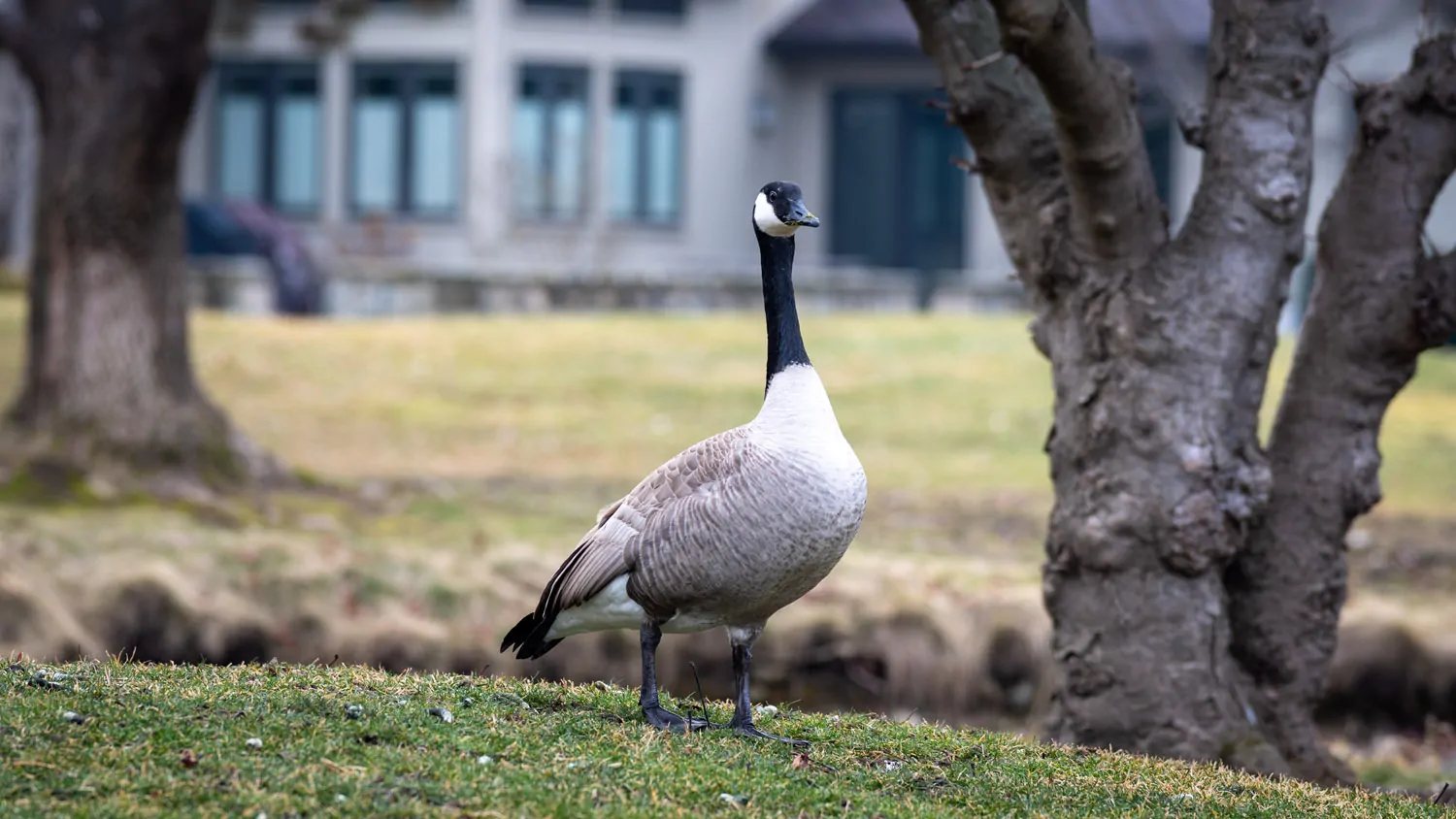
By late April, goslings begin to take over the Boise Greenbelt. The river is running high and cold, but the grass is finally warm, and the first broods of fuzzy yellow chicks are appearing everywhere along the water. It is a season of small, new lives finding their footing.
A man rides his bike along the asphalt on a Tuesday morning. As he approaches a goose standing near the edge of the trail, the bird remains still: alert, but silent. There is no hiss and no charge. Yet as the cyclist passes, he sticks out his leg and swings his foot toward the bird.
The Misread Boundary
To understand the goose, one has to understand the season. In late spring, a few square feet of dirt and grass beside the Greenbelt can become the most important place in the world.
During nesting season, a Canada goose is organized around one task: keeping the nest alive. While the female sits on the eggs, the male, the gander, keeps watch. His attention narrows to the perimeter around the nest.
The hiss is part of that perimeter. It marks the edge of the nest’s small world and gives the stranger a chance to move away. Something fragile is nearby. Give it room. To the goose, the cyclist is a large, fast-moving presence encroaching on the small patch of grass where a parent is keeping a nest alive.
The cyclist may have had a bad encounter with geese before. Maybe one hissed at him. Maybe one chased his child. Maybe he has simply heard enough people talk about geese as if they are a problem. By the time he reaches this bird, he has already decided what it is. The season, the nest, and the animal’s instinctive behavior are left out of the man’s calculation. He responds to the feeling the goose triggers before he has understood what is actually happening.
The Rule Built From One Moment
The feeling arrives first, and the explanation comes later. A single uncomfortable encounter can become a permanent rule if no one stops to examine it. Fear does this. So does embarrassment. So does inconvenience.
A goose hisses, and the entire species becomes “mean.” One public meeting goes badly, and City Hall is branded as corrupt. When an out-of-scale apartment building goes up, all new housing starts to look like a threat. If a few teenagers leave trash in a plaza, we begin to see every gathering place as a liability. When a public restroom is misused, the city often decides the simplest answer is to stop building them.
Each reaction begins with something legitimate. The goose did hiss. The meeting was frustrating. The building may have been poorly designed, and the plaza was left a mess. The error lies in letting one difficult moment become the entire story.
Pain remembered without judgment eventually becomes policy.
The Defensive City
A city built from misread stories eventually surrounds itself with deterrents. You can see them in the No Access signs, No Loitering warnings, and private property placards that gather along the edges of public space.
The pattern goes deeper than signage. It lives in benches shaped to keep people from resting, blank walls with no doors, fences where there could have been thresholds, and plazas designed to move people through quickly without giving them a reason to stay. Even public process can begin to feel like a deterrent when it is built mainly to control risk instead of building trust.
Most of these choices begin as practical responses to real problems: reducing liability, preventing repeat incidents, or managing something that once went wrong. A plaza loses its seating because someone once stayed too long. A trailhead gains a new warning because a few people behaved badly. A public edge is fenced because controlling a boundary is easier than caring for it over time.
A defensive city accumulates slowly, one small act of mistrust at a time. Each choice can be explained in a memo. Taken together, they teach residents that the city expects the worst from them. Over time, the landscape begins to train the same reflex as the man on the bike: narrow the eyes, brace for trouble, and act before understanding what is actually there.
What Boundaries Protect
There is another mistake to avoid. Some boundaries exist for good reasons. Some forms of resistance are trying to guard something real.
A resident pushing back against a new project may be trying to protect the stability of a street where they have lived for thirty years. A neighborhood worried about change may be protecting memory, continuity, and trust. An agency enforcing a rule may be protecting safety. A business owner cautious about public access may be protecting a fragile operation. A park worker closing part of a trail may be protecting restoration work that needs time.
A goose hissing beside the Greenbelt belongs in that same category. The sound may be unpleasant. The posture may feel aggressive. But the behavior is organized around the nest.
A serious city asks what a boundary is protecting before deciding what it means. A boundary can protect life, or it can shut life down. A rule can preserve trust, or it can become a substitute for judgment. A fence can guard restoration, or it can turn shared space into dead space. The form only tells part of the story. The deeper question is what the boundary is serving.
That is the difference between a defensive city and a discerning one. A defensive city reacts to discomfort by adding another layer of control. A discerning city pauses long enough to ask what is being protected, whether the response fits the situation, and whether the boundary still serves life.
Inquiry Before Intervention
A wiser civic culture protects the space between reaction and decision. A goose hisses. A resident pushes back. A teenager lingers in a plaza. A project meets resistance. The first reading is rarely enough. A city that reacts only to friction will keep adding fences and rules until it has managed away the life it was meant to steward.
The work begins by asking what the response is trying to preserve. We have to know if a threat is real or remembered, a recurring danger or a seasonal discomfort. Does the proposed rule solve the problem, or does it teach the community to expect less from public life? Some boundaries protect fragile things. Others close off the possibility of shared life.
This is the discipline of seeing before solving. A city with that discipline can still enforce rules and protect vulnerable places, but its first habit is interpretation. It learns to read the nest before it reacts to the hiss.
The Discipline of Seeing
The man on the bike could have shifted his path a few inches, given the goose its small perimeter, and kept riding. The encounter could have passed without conflict.
Civic life often turns on the same kind of interpretation. Many of our hardest conflicts begin in the instant we decide what kind of story we are standing inside. Once a resident is labeled an obstructionist, or a public place is branded a liability, the response begins to feel inevitable.
In a city growing as fast as Boise, perception is a primary responsibility. When a community is already braced for loss, inconvenience, or betrayal, the discipline of seeing clearly becomes all the more important. A mature civic culture asks what is being protected and whether the response fits the reality in front of us.
The gander was guarding a nest, and the city is full of them: fragile projects, young families, small businesses, public spaces, damaged trust, and new forms of life trying to take root. Some need protection. Some need reform. Some need room. All deserve to be read before they are judged.
Before we kick, fence, ban, or retreat into a permanent story, we owe Boise the discipline of seeing what is there.
