
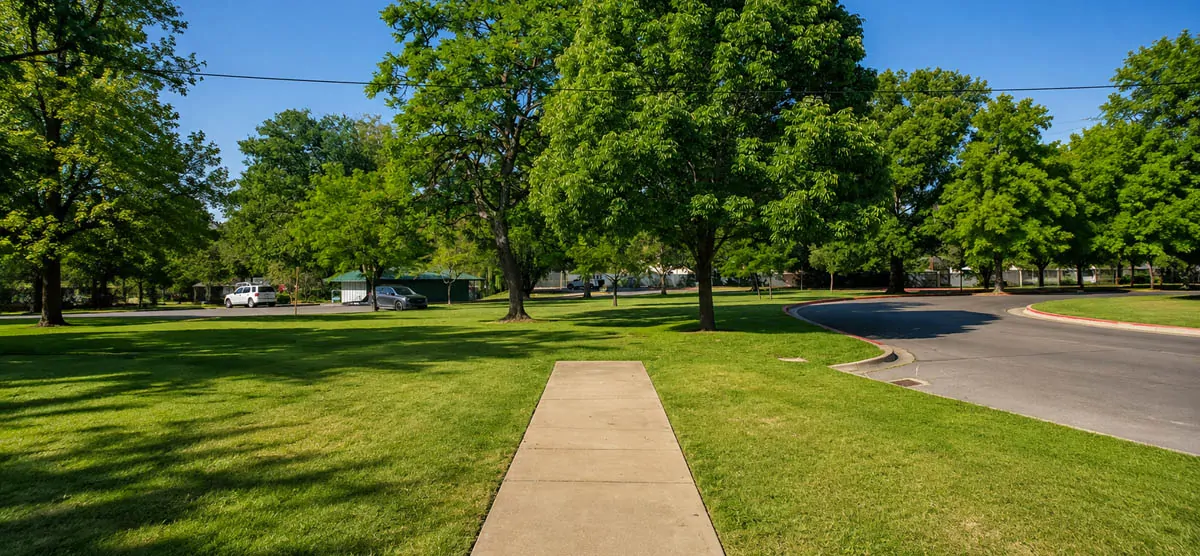
On the northern edge of Julia Davis Park, near the Discovery Center, a sidewalk starts toward the park and then stops.
If you are walking down from River Street toward the paddleboat pond, the concrete guides you along the curve of the road as if it knows where it is going. Then, at the seam where the street meets Julia Davis Drive, the thought breaks off. The path stops short, leaving a wide piece of grass between the sidewalk, the park trails, and the nearby parking lot.
There is no construction fence, no detour sign, no obvious reason. The sidewalk just gives up.
You can look across the lawn and see where you want to go, but the built environment refuses to take you there. Instead, you are left standing on the edge of the pavement, forced to trudge across a gap of grass and mud just to complete the journey. It feels like someone trailing off and walking away in the middle of a sentence.
An abrupt dead end like this is easy to pass off as a minor oversight. But small things are useful because they reveal what a system has learned to ignore. At this boundary line, public attention ran out. The municipal mind stopped thinking, and handed its unfinished thought to the human body.
We understand this kind of friction in a room. A desk covered with unopened mail, tangled cords, loose tools, and half-finished projects turns attention into a physical record. The room shows what has been deferred.
A good room lowers the cost of action. It handles background logistics, leaving you free to focus. In a disordered room, the body has to keep finishing the mind’s unfinished work: clearing the surface, finding the tool, untangling the cord, and putting the room back into working order.
A city works the same way. Its sidewalks, crossings, curbs, signals, benches, shade trees, park edges, and paths show where public attention held and where it drifted away. A coherent street lets the body move without solving every seam. A broken one keeps handing small problems back to the person walking through it.
A community can publish master plans and values statements, but the more honest record is usually written on the ground. A bike lane that vanishes before the dangerous intersection. A crosswalk painted where drivers are least prepared to see people. A public plaza with no shade, no seating, and no reason to stay. A sidewalk that ends in grass.
In each case, the paperwork may be complete. The human journey is not. A place becomes ugly when it asks the human body to absorb contradictions the design never resolved.
A broken pathway may seem minor on its own. Repeated across a landscape, these gaps become an unspoken lesson. They teach a community that walking is secondary, continuity is optional, and the person moving through the city is responsible for adapting to what the system left unfinished.
This is one way public cynicism takes root. Scandal, corruption, and political failure damage civic trust, but so does repeated contact with places that make people feel unconsidered. A missing path, a vanished bike lane, a hostile crossing, a park edge that refuses its neighborhood: each one is small on its own. Together, they teach people that the public realm was not designed with their movement in mind.
Repair begins by finishing the thought. Connect the sidewalk. Carry the bike lane through the intersection. Shape the park edge so it welcomes the surrounding neighborhood inside. Give the person walking a coherent route through their own community.
A sidewalk that ends in grass is a small detail, but cities teach through small things: thresholds, crossings, paths, benches, edges, and the ordinary continuity of care. When the path gives up, the person has to finish the thought. A mature city does not keep handing its unfinished thoughts to the people walking through it.
