
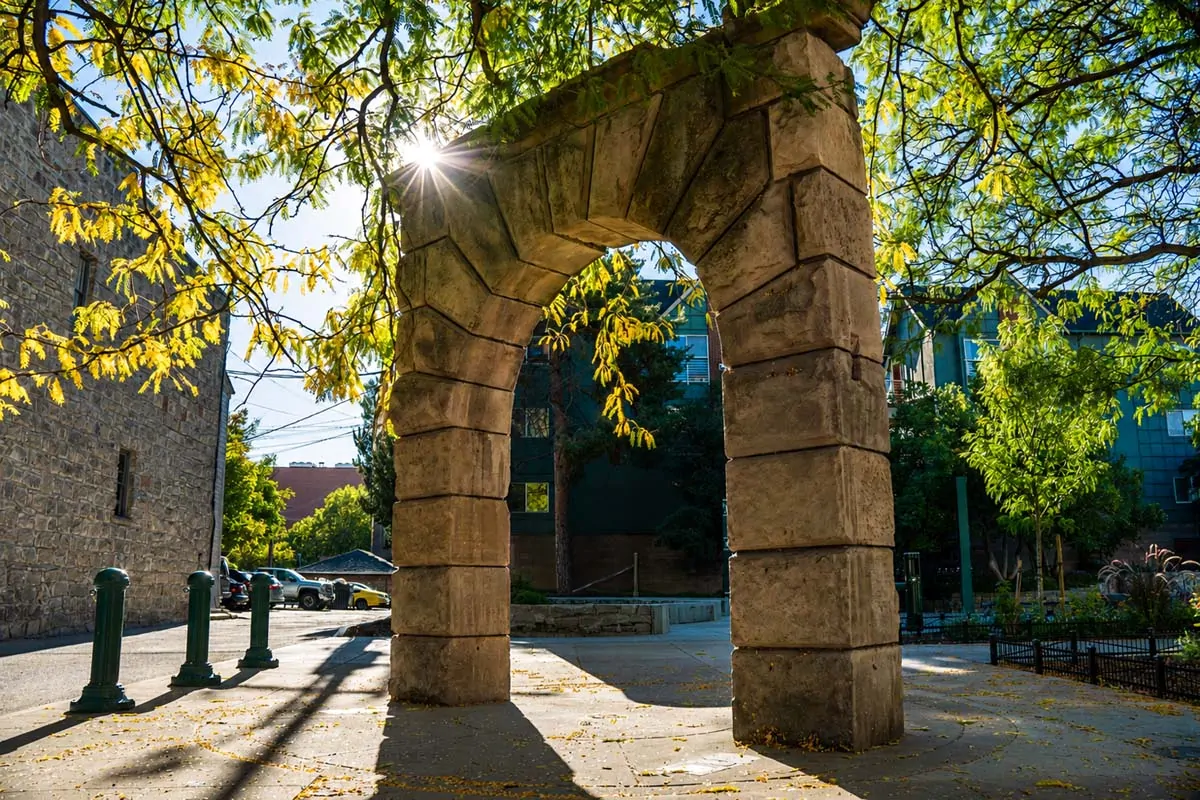
If you want to understand when a city begins to lose confidence in itself, look at what it does to its gateways.
In the early 1960s, London demolished the old Euston Arch, the grand stone entrance that had stood before Euston Station since the dawn of the railway age. The old arch gave the station a public face, a massive Doric entrance that made arrival in the capital feel like an event. The argument for demolition sounded practical: the old station was inefficient, the arch was expensive to relocate, and the modern railway needed a clean, flexible terminal. In that frame, the arch became an obstacle. A civic threshold was reclassified as an inefficiency.
The new Euston Station opened later that decade as a flat, dark, utilitarian complex of concrete and glass. Decades after the demolition, much of the old arch was found buried in the Prescott Channel in East London, where its hand-carved stone had been dumped as fill. A gateway to the city had become rubble in the mud.
We have spent half a century calling this realism. We treat beauty as a luxury, a subjective preference, or a late-stage line item to be negotiated down the moment a budget tightens. We decouple the visible form of our world from the life inside it, operating on the false premise that buildings, streets, and neighborhoods can be engineered for utility first and made humane afterward.
Human beings experience the built world with the body first. Before the mind begins forming an opinion, the eye is already reading proportion. The ear is reading sound. The skin is reading exposure. The body is reading light, texture, enclosure, scale, and the distance between itself and the nearest threat or refuge.
Beauty begins in that first reading. A well-ordered place gives the body less to defend against. The nervous system does not need a theory of architecture to understand a room with good light, a street with human scale, a threshold that offers choice, or a material that feels built to last. The place makes sense before it has to be explained.
When those qualities are stripped away in the name of efficiency, the cost relocates into the people who must inhabit the result. The eye works harder. The body tightens. Attention fragments. A person spends energy tolerating exposure, noise, glare, blankness, and disorder that should have been resolved by the builder, planner, or institution.
That is the hidden invoice of treating beauty as a remainder. The cost eventually appears as burnout, neglect, turnover, loneliness, and distrust. A city pays for its disregard somewhere. Beauty has to enter early enough to shape what the city becomes. Once the deeper decisions have been made, it can only decorate the damage.
The Readable Surface of Health
To understand why this signal matters, we have to look past the modern tendency to confuse beauty with mere prettiness. Prettiness is superficial; it can be applied, purchased, and laid over a weak structure. Beauty is a deeper, more rigorous phenomenon entirely. It is what happens when many hidden layers of reality are brought into right relationship.
Consider a healthy human face, a thriving garden, a well-made room, or a mature city street. Each one carries more than surface appeal. A face often grips us because symmetry, clarity, and vitality are read together before we consciously separate them. A thriving garden holds the eye because it reveals balanced soil, proper water, complex ecology, and attentive care. A good room has proportion, light, depth, texture, and a sense that the body can settle there. A mature street gathers buildings, trees, thresholds, movement, and human scale into a pattern people can understand. Beauty is the attractive surface of hidden coherence. It lets the body recognize layered health before the mind has to explain it.
The body is built for rapid environmental judgment. Vision, hearing, balance, touch, and spatial awareness are constantly sampling for order, exposure, boundary, refuge, path, and scale. Most of this happens before deliberation. Beauty belongs to that first layer of perception. It is the felt recognition that many signals are resolving into order.
When this signal is present, it sets off a functional sequence that dictates how human beings navigate and inhabit public space. It begins at the sensory level: a legible environment allows the eye and body to read the landscape without physical strain, making clear perception possible. From that clarity, orientation follows naturally; a person can safely locate themselves within a predictable, meaningful field. Over time, this ease of orientation stabilizes into a shared sense of coherence. Buildings, paths, thresholds, signs, habits, and public behavior begin to support one another.
Once an environment feels coherent, trust takes root. People no longer have to treat the world around them as arbitrary, careless, or extractive. They begin to spend less energy defending themselves from the place and more energy participating in it. From that trust, real civic prosperity becomes possible. People invest, repair, gather, build, and stay because the place gives them reason to believe their effort will not be wasted.
Prosperity depends on trust, and trust depends on coherence. Beauty matters because it is one of the first signs that coherence is present. A beautiful form looks right because unseen systems beneath the surface have been ordered toward life.
The Invoice of Systemic Ugly
If beauty is the signal of integrated health, ugliness deserves the same structural seriousness. Ugliness is the visible evidence of a system refusing coherence. A place becomes ugly when it asks the human body to absorb contradictions the builder, developer, or institution refused to resolve.
When a structure is designed with total indifference to its context—built to maximize short-term yield while externalizing long-term friction—the resulting form becomes jagged, fragmented, and illegible. It is an architecture of unresolved tensions. It places a cold concrete wall directly against a sidewalk, drops an unshaded asphalt parking lot into a residential neighborhood, or builds boundaries so thin that the inhabitant is forced to participate in the private life of their neighbor.
This is where the supposed efficiency of modern, low-care construction reveals its true nature. When a project saves money by ignoring human scale, acoustic dignity, and natural light, the missing care reappears as an ongoing operational debt. Systemic ugliness always sends the bill somewhere. Usually, it sends it to the nervous system.
The invoice is delivered every single day. Bad housing sends the bill to residents who can never quite find true rest because their home forces a state of low-grade vigilance. Bad streets send the bill to pedestrians, who must spike their adrenaline just to cross an intersection built exclusively for vehicular throughput. Bad landscapes send the bill to the public in the form of urban heat islands, bleak exposure, and deep social loneliness. Bad policy sends the bill to the entire rhythm of daily life, fracturing the city into compliance boxes that make sense to a bureaucracy but feel totally incoherent to a human being.
A community cannot build public trust if its physical form repeatedly teaches distrust. When we force people to inhabit environments that feel arbitrary, hostile, and careless, we are implicitly telling them that their presence does not matter and that the world around them cannot be trusted. People handle that message the only way they know how: by retreating, tightening, and pulling away from the public square.
Beauty Across Scale
This pattern appears at every scale of the city, beginning with the home. True beauty in housing starts long before the eye registers a finish or a fixture. It begins with the way a house receives a person: the entry, the light, the relationship between public and private rooms, the view from the kitchen sink, the shade over the porch, the thickness of the walls, the ability to rest, gather, cook, work, and recover without the house constantly working against the life inside it.
Modern development often confuses luxury with cosmetics. Stone counters, black fixtures, and staged interiors can photograph well while the deeper order is weak. A home proves its beauty by how well it supports daily life. Can a person enter with a sense of arrival? Can a family gather without the room fighting them? Can the house hold both solitude and hospitality? Can it age into dignity? The first beauty of a dwelling is the feeling that the life inside it has been genuinely considered.
When we step through that front door, the lens widens to the street. A beautiful street is a moral landscape that lowers the metabolic cost of being in public. It uses legible edges, human-scaled storefronts, and protective buffers to teach the body that it belongs there. An ugly street treats the pedestrian as an obstacle to throughput, forcing the body into a state of high exposure where every crossing is a calculation of survival. A street achieves beauty when movement, commerce, rest, and encounter can share the same physical order. The geometry itself invites people to pause, trade, walk, and look each other in the eye without paying a physical tax for the privilege.
Connecting the home to the street is the landscape, which is far more than an aesthetic afterthought. Landscape is the living tissue between building, body, climate, street, and season. In an incoherent project, plants are used as cosmetic filler, a patch of turf or a generic shrub dropped into leftover space to check a compliance box. A tree is living infrastructure. It shades the sidewalk, cools the wall, marks a threshold, shelters a bench, and binds the community to the rhythm of the year. It transforms a concrete canyon into a breathable, humane corridor.
Finally, the lens expands to municipal policy, the layer of rules that shapes what can be built, protected, funded, and maintained. Policy can be ugly or beautiful in its own right. A regulatory regime is ugly when it sees only what the administrative system can measure—setbacks, parking ratios, traffic counts, and compliance boxes—while producing places that feel utterly illegible to a human being. A city can comply with every rule on the books and still build a landscape that no one can love. Policy becomes beautiful when it protects the conditions under which human life can flourish: scale, shade, thresholds, acoustic dignity, walkability, and long-term stewardship.
The same standard applies beyond buildings and streets. A school can be beautiful when its rooms, rhythms, authority, discipline, and care help children become more ordered and capable. A clinic can be beautiful when the person entering it is received with clarity, dignity, and competence rather than processed as a problem moving through a queue. A court, a public meeting, a park system, or a police encounter can carry beauty when structure, restraint, purpose, and human dignity are held together well. Beauty appears wherever a civic system makes life more legible, more trustworthy, and more worthy of responsible participation.
When these scales align, the whole civic structure becomes more durable. Homes protect rest. Streets and landscapes support public life. Schools, clinics, courts, parks, and public institutions carry people with clarity and dignity. Policy secures the pattern across generations.
The False Realism of Ugliness
The primary defense of systemic ugliness is usually called pragmatism. Beauty is treated as an expensive premium, an optional upgrade that disappears when the construction budget tightens. Proportion, craft, ornament, mature landscape, shade, durable materials, and human scale are treated as luxuries rather than civic foundations. The supposedly realistic project narrows itself to compliance and yield.
The problem is that a construction budget is only the first ledger. It records land, labor, materials, financing, insurance, permitting, and code compliance. It is much less capable of recording the fatigue imposed by a badly scaled corridor, the distrust created by a building with no public grace, the loneliness produced by hostile public edges, or the steady maintenance burden created by materials and forms that never gather care around them.
A building engineered around weak materials, exposed thresholds, poor shade, thin assemblies, and sterile public edges may look efficient at the moment of delivery. The savings are visible early. The costs mature slowly. Residents endure them in daily life. Neighbors work around them. Owners manage them through repairs, security, turnover, and defensive rules. Public agencies absorb them through enforcement, emergency response, and eventual redevelopment pressure. Over time, the building nobody loves becomes one of the most expensive structures in the city because care never gathers around it.
Realism begins by admitting that human beings have bodies. Those bodies respond to physical space. When an environment is built without light, silence, shade, and human scale, the body pays a physical tax to inhabit it. The cameras, fences, warning signs, and constant programming required to stabilize a hostile public space are the financial interest paid on an early decision to leave beauty out of the structure.
A truly practical city accounts for the whole life of a place. It sees beyond the opening budget and asks what the project will require from the people who must live with it, maintain it, pass by it, repair it, explain it, defend it, and eventually decide whether it is worth keeping. Ugliness becomes expensive because it keeps demanding compensation from everyone around it. Beauty matters because it reduces that burden at the source.
The First Builders
Boise needs builders who can recognize beauty before it becomes decoration. That word belongs to more than construction. A builder is anyone whose decisions shape the conditions other people must live inside: the developer choosing a site plan, the educator shaping a school day, the public official writing a rule, the funder setting the terms of support, the institutional leader designing a public encounter, the neighbor deciding what kind of place is worth defending.
Beauty becomes serious when it is allowed to govern those decisions early. It has to be present while a project, policy, institution, or public practice is still capable of becoming coherent. After the deeper structure has hardened, beauty loses its authority. It can soften the surface, improve the language, add warmth, and reduce some harm. The formative decisions have already been made.
The questions have to move upstream. What kind of person will this produce? What kind of trust will this require? What kind of behavior will this reward? What burdens will it place on the body, the neighborhood, the staff, the public, and the next steward? Will this age into dignity, or will it need to be defended, explained, repaired, and compensated for year after year?
The first builders are the people willing to ask those questions before the work becomes expensive to change. They understand that a city matures when its forms begin to support the life they claim to serve. Rest, movement, learning, healing, trade, judgment, service, and belonging all require structure. When that structure is coherent, people have less to fight through and more capacity to contribute.
A city that treats beauty as a leftover will eventually become a place of leftovers: leftover land, leftover attention, leftover trust, and people trying to recover privately from public disorder.
The old mistake is always available: reclassify meaning as inefficiency, then live inside the result. Boise still has the chance to choose another pattern. The work begins by remembering what the body knows before the mind explains it.
Beauty is the first signal. A serious city learns to read it.
