
“The essential function of art … is to become personally enlightened, wise, and whole.”
— Peter London, No More Secondhand Art
The Radio Reflex
Every driver has done it. You’re in traffic, trying to read a street sign, find a driveway, or spot a house number before you miss the turn. The car is moving, other cars are close, and your mind is already doing several things at once. Then your hand reaches for the radio and turns the volume down.
There is something funny about it. The music is not hiding the street sign. The radio has no effect on the house number. But your brain is already busy enough, so you start clearing out anything extra. The music goes down. The conversation pauses. You find the turn, get back on track, and then the radio can come back up.
The same reflex shows up in civic life. Boise puts real effort into public art, planning materials, newsletters, signs, and invitations to participate. Some of it is thoughtful. Some of it is beautiful. And still, a lot of people move through the city as if none of it is there.
From inside an institution, that can look like a communication problem. Maybe the message needs to be clearer. Maybe the design needs more color. Maybe the announcement needs to go out one more time. But there may be a deeper issue. The city is trying to send cultural signals through places that have not been built to receive them.
The Dark Gallery
Imagine producing a gripping documentary, but no one has a screen to play it on. Or writing a moving song for a city that has no speakers. You could hang a masterpiece in a gallery, but if the power is out and the room is pitch black, the painting is effectively invisible.
This is the nature of the gallery problem. We tend to think of public art and civic culture as things that just happen to a city. As if you can simply drop a sculpture onto a sidewalk and expect it to resonate. But art is a signal that requires a receiver. It needs a container designed to hold our attention.
In Boise, we often ask art and civic messaging to do their work in places that are already too loud, too exposed, or too hurried to hold attention. The sculpture may be thoughtful. The plan may be clear. The invitation may be sincere. But people receive those things through the actual street in front of them: the traffic, the shade, the walls, the crossings, the noise, and the pace of movement around them. That is where the physical environment matters.
When a street is built mainly to move cars quickly, everything else has to compete with that purpose. A sculpture beside that street is still visible, but it is working against the noise, the speed, and the feeling that a person should keep moving. The same problem shows up in an exposed plaza. A gathering can be planned there, and the invitation can be sincere, but if the space offers no shade, edge, shelter, or reason to linger, people will pass through. Even the word “community” starts to feel thin when it is placed somewhere no one wants to stay.
The place itself has to be strong enough to hold the kind of life we are asking people to notice, join, and care about. This applies beyond public art. Planning departments face the same condition when they ask residents to engage thoughtfully with streets, corridors, and neighborhoods that the built environment has already trained them to experience as places of stress or disconnection. A person cannot easily care for a place they have mostly been taught to pass through.
Vitality Versus Chaos
A good public place can be loud. It can be crowded, active, and full of movement. Anyone who has sat in a busy square, market, or festival understands this. The sound itself is not the problem. People can spend hours in a lively place when the space gives the energy some order. There are edges. There are places to sit. Movement has a pattern. The scale still feels human.
In physics, this is called laminar flow: movement that has direction and order. The public version is a place where many things are happening at once, but the body can still read the pattern. That kind of energy can be stimulating without becoming stressful. It feels active, but it does not feel out of control.
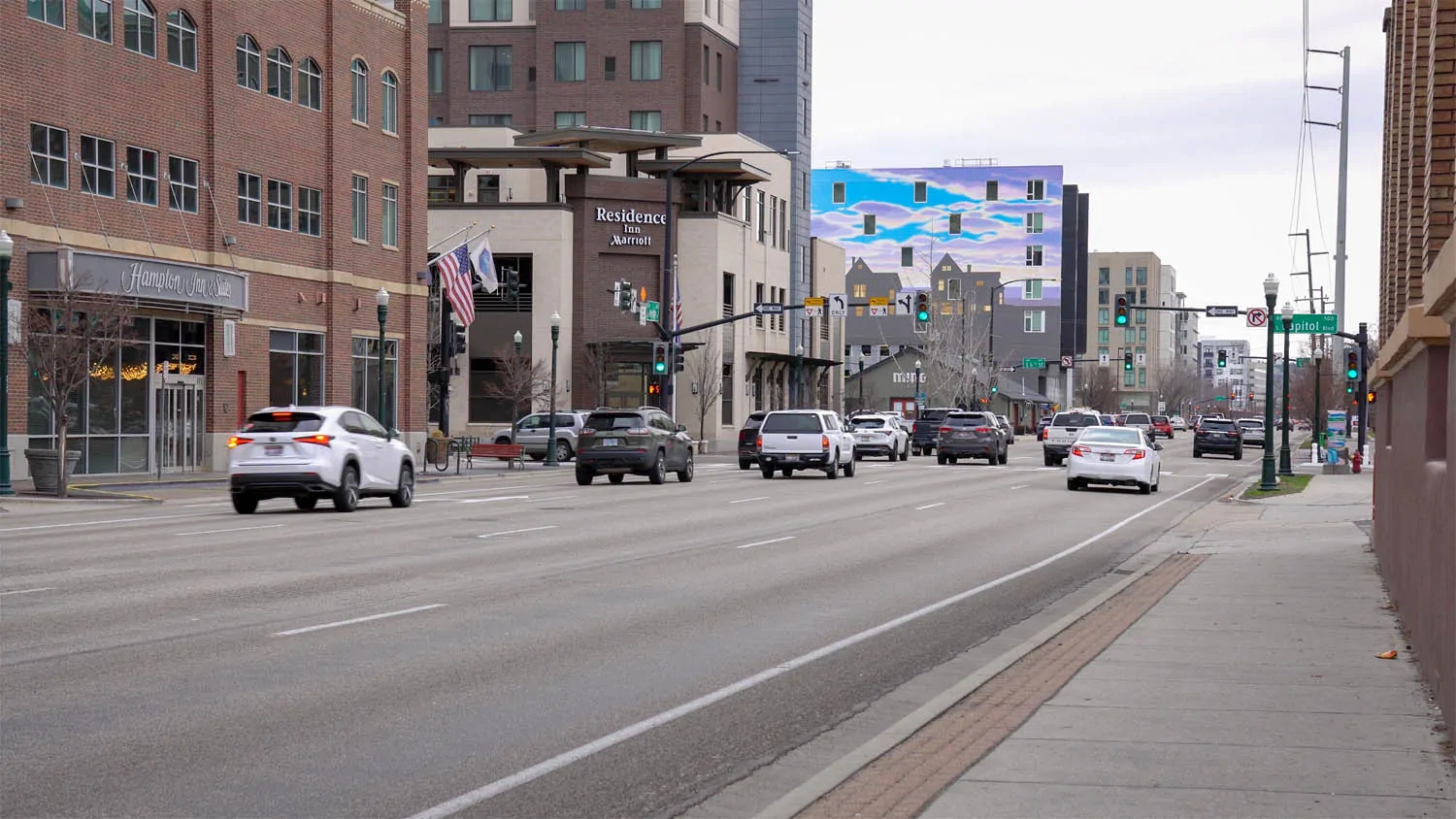
The opposite is turbulent flow. The energy does not move in a pattern the body can easily read. It comes from different directions at once: fast traffic, exposed sidewalks, signs, curb cuts, parked vehicles, turning cars, and the constant need to track what might cross your path. Much of Boise’s public realm has this quality. It is active, but the activity does not gather into a place.
In that kind of environment, the body stays alert. A person may still be walking past art, storefronts, trees, or signs of civic life, but the main task is navigation. The street is asking them to keep moving, watch their edges, find the crossing, avoid the vehicle, and get through. There is little attention left over for the things a city hopes they will notice.
The Need for Rooms
Boise needs public places with enough shape for people to understand where they are supposed to be.
The body reads edges quickly. A wall, a tree canopy, a row of buildings, a low planter, a shaded corner, or a change in paving can tell a person that they have arrived somewhere. These cues give public life a place to gather. Without them, people keep moving because the environment never gives them a clear invitation to stay.
This happens when a plaza has no real edge, or when a sidewalk is just a narrow strip of concrete beside fast traffic. The body keeps doing the work of navigation. It watches the street, tracks movement, manages noise, and looks for the next place of safety. What can look like disinterest is often self-protection.
People rarely settle in places that keep asking them to brace. They pass through and keep looking for somewhere that feels more held.
The 8th Street Case
You can see this mismatch on 8th Street, one of Boise’s most intentional cultural corridors. Near 8th and Front, small public installations sit in the pavement and along the sidewalk: patterned discs representing constellations and delicate metal sculptures rising beside them. The pieces are careful and locally rooted. They are clearly trying to carry some part of Boise’s story.
But look at the perceptual field around them. A large pickup truck is parked inches away from the sculpture. A weathered lamp post nearby has chipped paint at its base. Storefront signs, traffic lights, and the constant turnover of parking spots compete for every inch of your attention.
The result is a collapse of hierarchy. Because the surrounding environment is still organized around vehicle flow and visual noise, the artwork becomes background, even though it was meant to be the focus. Your eye doesn’t linger on the sculpture because your nervous system is too busy tracking the movement of the truck or the clutter of the street.
The art, the businesses, the parking, and the street infrastructure are all doing understandable things. The conflict comes from how they stack together. Objects meant to carry symbolic meaning are crowded by objects built for utility, movement, and turnover. The brain reads the whole scene quickly and treats it as a corridor. In a corridor, people navigate. They track movement, avoid obstacles, and keep going. That changes how they receive the art, the storefronts, the signs, and the people around them.
The Street Performer Problem
The 8th Street example reaches beyond the objects themselves. It also touches the people we ask to create them. Boise has musicians, painters, sculptors, writers, designers, and storytellers capable of giving the city a richer public life. When the city offers them mostly corridors, their work has to compete with traffic, signage, parking turnover, and the ordinary pressure to keep moving.
That is what a street performer does. They bring real skill into a place designed mainly for movement and try to create a pocket of attention inside the flow. Sometimes it works beautifully. Someone stops. A small crowd gathers. For a moment, the corridor becomes a room. The performer is still working against the basic instruction of the place: keep moving. Even a gifted street performer is shaped by that setting. The crowd is passing through. Attention is brief. The artist has to earn every second against the grain of the place.
Public art can get trapped in the same condition. A piece may be made with care, belong to the place, and carry a real story. When it sits inside a field of traffic, signage, glare, and movement, most people encounter it while they are already trying to get somewhere else. The work becomes one more thing to process, even when it deserves more attention than that.
A city that values its artists has to give their work a better setting. It needs rooms, thresholds, plazas, walls, corners, and edges where attention can gather naturally. Public art belongs in the life of the city. The city has to give that work places where people can slow down long enough to meet it.
Technology as Higher-Resolution Sight
Some parts of the gallery problem are easy to feel and hard to prove. A person can stand on a sidewalk and know the place feels wrong. Too exposed. Too loud. Too much glare. Too many moving objects to track at once. The body registers the strain before the planning document has a category for it.
For decades, cities have been very good at measuring some things and very poor at measuring others. We can count cars, parking spaces, square footage, and traffic speed. We have had a harder time measuring shade, enclosure, visual clutter, sound, attention, and the subtle conditions that determine whether a person wants to stay.
That is where modern tools can help. They can give clearer form to things people already experience in their bodies. They can help map where shade fails, where noise peaks, where sightlines break down, and where the street keeps people moving because it gives them no reason to pause.
The point is to see the human experience of a place with greater precision before deciding how to change it. Technology can help with that task, but it cannot replace judgment. The work still ends in physical places: calmer streets, clearer thresholds, better rooms, and environments where the body can ease up enough to receive what the city is trying to give.
Building the Gallery
If Boise wants its culture to be seen, it has to build places that make seeing possible. That means more than activation, programming, or better marketing. It means a deeper kind of hospitality: calmer streets, stronger edges, clearer thresholds, and public rooms where attention has somewhere to gather.
Technology can help us see those conditions with more precision. The tools can show where shade, noise, traffic stress, and visual clutter are working against human attention. But the work still has to become physical. It has to become streets, corners, crossings, plazas, and rooms where people can exhale and become available to the place around them.
Boise already has talent, art, civic effort, and a story worth telling. The next task is to build more places capable of carrying those things. When the environment is too turbulent, people turn the radio down. They move through the city focused on navigation, not reception. If Boise wants a richer public life, it has to stop asking culture to shout over the thoroughfare. It has to build the room.
