
The Impossible Private Project
We stopped building cathedrals and told everyone to build one inside themselves. That was always too much to ask.
Modern culture gives the individual an assignment too large for private life: regulate the nervous system, curate the self, maintain relationships, locate purpose, recover from overload, and remain hopeful inside environments that often offer little help. Meaning has been converted from a shared inheritance into an individual burden. The isolated person is now expected to do internally what whole civilizations once helped carry externally.
This is a structural crisis masquerading as a personal deficit. A person can practice discipline, seek wisdom, build relationships, and pursue meaningful work while still becoming depleted by a world that gives almost nothing back. Personal discipline matters. It works best when supported by legible places, shared rhythms, and public forms that make belonging and responsibility easier to practice.
Meaning was never meant to be a lonely scavenger hunt. Human beings have always needed structures capable of carrying internal weight. By stripping those structures away, modern life has forced the individual to lift a burden too large for private life alone.
Modern life keeps asking the individual to compensate for what the shared world no longer provides. That is why so many people are tired in ways they cannot fully explain.
The Weight Only a Civilization Can Carry
To understand the depth of this depletion, we have to look at the shared supports that were removed before the individual was told to stand alone.
Historically, meaning existed as a tangible, environmental reality long before it became an intellectual problem. For thousands of years, the human mind did not have to generate order from scratch each morning because the surrounding world helped carry that order. The settlement, the household, the public square, the calendar, the place of worship, the market, the workshop, and the path of return all formed a kind of distributed scaffolding.
When a person stepped out of private life, the world itself offered orientation. The placement of the square, the framing of landmarks, the boundary between public and private life, and the repeated rituals of gathering all served as psychological anchors. The environment reflected a person’s history, obligations, and place within a larger order back to them.
Modernity brought real gains in liberty, knowledge, mobility, medicine, and material power. Its error was assuming that older structures of orientation could be removed without replacement. Human-scale beauty disappeared from many streets. Public life was compressed into traffic, transaction, and administration. Neighborhoods lost their centers. Daily rituals became private preferences. The shared world began offering less structure while asking the individual to supply more from within.
Then came the deeper error. After clearing away so much of the external scaffolding, we handed the burden back to the individual and called it freedom. We now expect people to summon their own psychological boundaries against acoustic chaos, engineer private rituals inside isolated subdivisions, and discover deep connection in landscapes designed around speed, separation, and consumption.
The individual mind grows best inside an ordered reality. It receives strength from the forms around it: a stable home, a legible neighborhood, a shared calendar, a meaningful public life. A human being can carry responsibility, practice discipline, and contribute meaningfully to the whole. Each life can hold its share of the common roof. The sky itself belongs to the civilization.
The Kind of Building This Crisis Requires
When a civilization encounters a structural crisis, it usually answers by building. The American tradition is marked by this instinct. When distance threatened to fracture the continent, we built railroads. When flooding, water, and energy demanded a larger response, we built dams. When communities needed access to knowledge and civic formation, we built libraries, universities, schools, and public institutions.
The underlying principle was sound: large problems require shared structures. Our current emergency is harder to see because it does not appear first as a broken bridge or a failing power grid. It appears as loneliness, overload, cynicism, distrust, and the strain that comes from having to invent meaning in isolation.
Because these wounds are felt inwardly, they are often assigned to the individual. Anxiety becomes a private management problem. Loneliness becomes a social-skills problem. Disorientation becomes a matter of mindset. But when the same strain appears across households, neighborhoods, workplaces, and generations, the pattern deserves a larger diagnosis. A society that asks people to manufacture meaning alone has already withdrawn too much support from the shared world.
A crisis of meaning cannot be solved only through introspection. It has to be answered in the world people return to every day.
That requires a larger understanding of infrastructure. Standard municipal planning focuses on utilities, roads, housing counts, and economic development. Those things matter. They keep a city functional. But function alone cannot hold a people together.
A civilization facing a crisis of meaning has to recover civic architecture in its fullest sense. It has to build forms that do real interior work: homes that let people recover, streets that lower vigilance instead of raising it, public rooms that gather attention, paths that make return feel natural, and civic rituals that give people a recurring place in the life of the city. These forms carry real civic weight. They steady attention, support connection, and give responsibility a place to become visible in ordinary life. A city that builds them well gives people more than services. It gives them a world capable of helping them stand upright.
The task is to rebuild the physical scaffolding that helps human beings remain oriented, grounded, and capable of contributing to the whole.
Rebuilding the Civic Container
If an environment requires its residents to become spiritual geniuses or masters of psychological resilience just to maintain their sanity, that environment is broken. An ordinary human life should be supported by its surroundings. Heroic resistance is a noble trait, but it is an impossible foundation for a stable society.
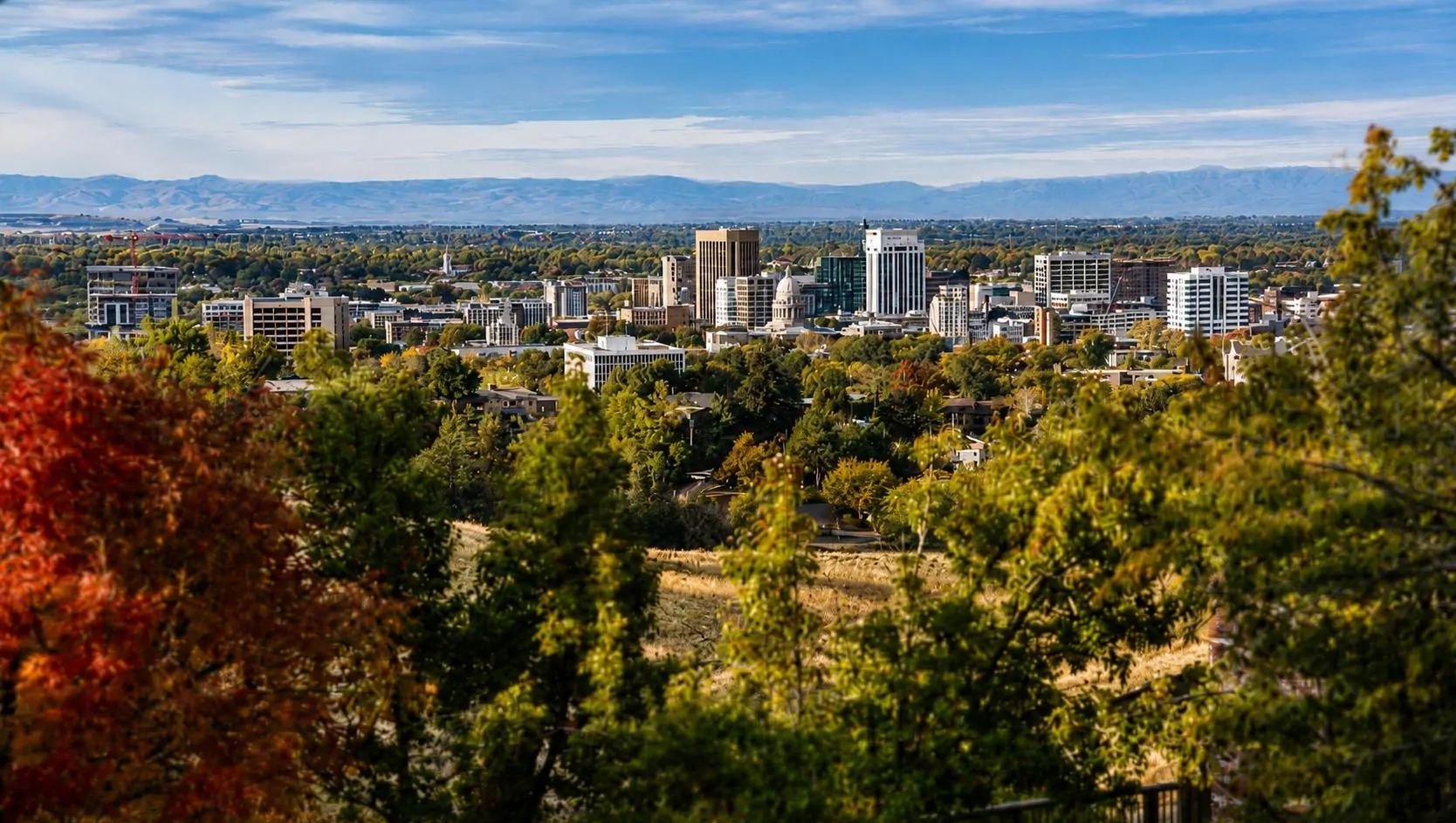
This realization defines the work of Boise Rising. The objective is to return part of the regulatory burden to the shared world, where it belongs. A grounded life should not require constant private effort. The city itself should help carry the pattern.
Connection and shared meaning have to live somewhere. They grow through the places people return to, the rooms where they gather, the tables where they talk, the landmarks they recognize, and the public spaces that become part of memory over time. At a small scale, this is easy to understand. A hearth, a trail, a garden, or a stone marker can hold meaning because people know how to gather around it and care for it. At the scale of a modern city, the same work becomes much harder. It requires vision, coordination, and the discipline to treat place as something entrusted to us, rather than as space to be used up quickly and forgotten.
That is what Boise Rising means by rebuilding the civic container. The work is to shape Boise so ordinary life receives more support from its surroundings. This means giving neighborhoods clearer centers, making streets feel more humane, strengthening public places that carry memory, and helping shared rituals become part of the city’s ordinary rhythm again. When those conditions are present, community becomes more than an administrative goal. It becomes part of the daily pattern.
Boise still has the scale required for recognition. Its landmarks remain visible. Its neighborhoods can still be named and understood. Its fractures can still be traced on foot, by street, block, the Boise River, the Bench, the Foothills, and the corridors that hold the city together. The city has not yet grown beyond the reach of deliberate care. Its growth is becoming more complex, and the habits that once worked through familiarity are beginning to fail under pressure. There is still time to choose a more coherent pattern before scattered growth becomes the shape of ordinary life.
The heavy lift belongs to the civilization. A person can carry discipline, love, work, attention, and responsibility. The shared world must carry the larger frame that allows those efforts to cohere. That is the work ahead: rebuilding a city where meaning is supported by the world people return to every day.
