
The Great American Irony
Every year, millions of Americans perform a strange financial ritual. We spend 50 weeks working in environments we merely endure—office parks, drive-thrus, and car-dependent subdivisions—to save enough money to spend 14 days in a place that looks nothing like our daily reality.
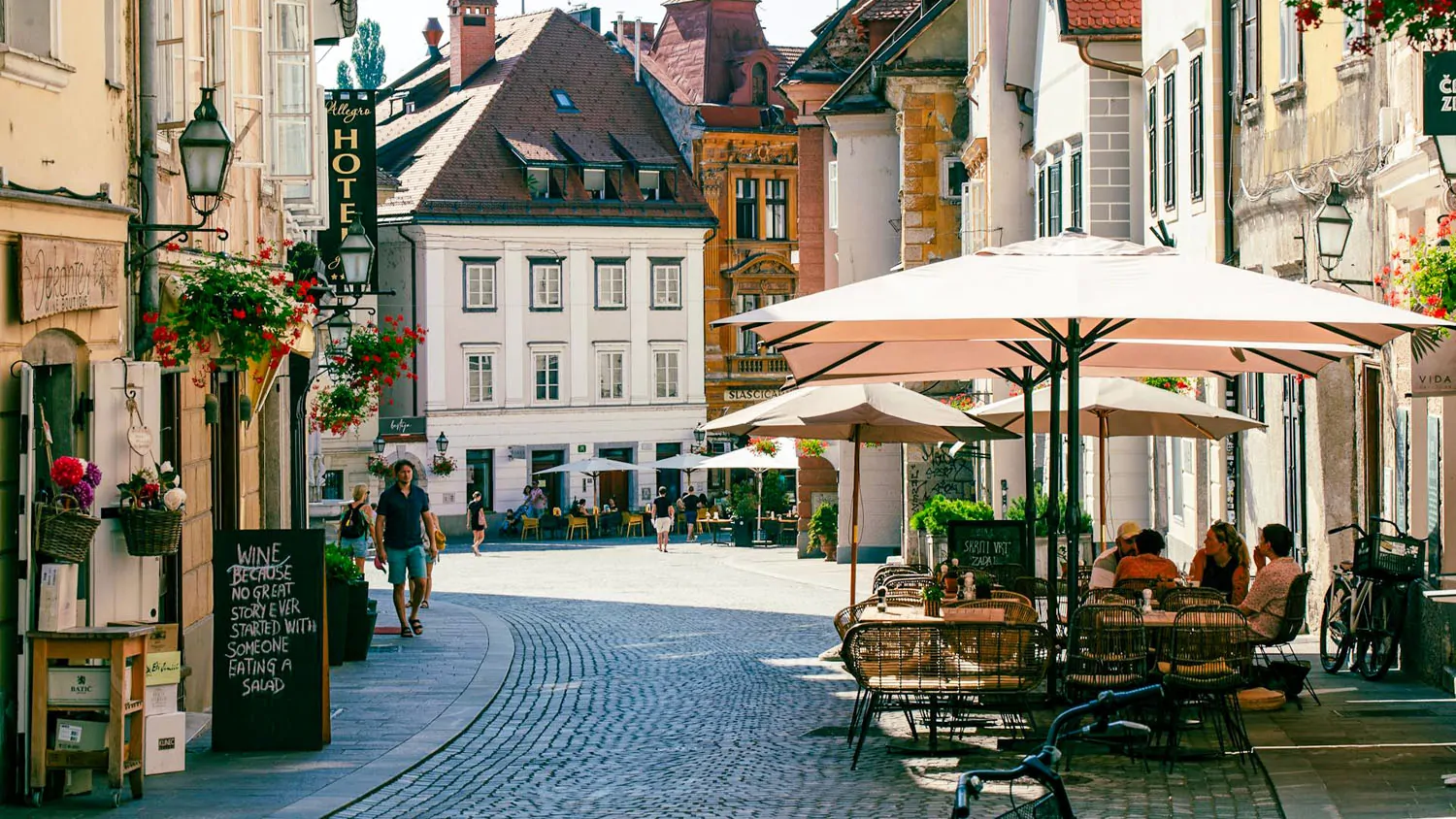
We fly to a village in Tuscany, a historic square in Savannah, or a coastal town in Maine. We might even pay a premium to walk down a simulated “Main Street” at a theme park.
We tell ourselves we are buying sightseeing or relaxation. Look closer at the credit card statement. What we are actually purchasing is the rare opportunity to exist as a human being without a car. We are paying for the privilege of walking to breakfast, sitting in a square that wasn’t designed for throughput, and feeling the calm dignity of an environment built to human scale.
This is the great irony of modern American life: we spend our wealth to escape the very world we spent our wealth to build.
A question should haunt every planning meeting and development board: Why is “The Good Life” something we have to fly to? Why is it something we aren’t allowed to build at home?
The Density Paradox
This contradiction reveals the core tension in how cities grow. On vacation, the preference is almost always for density. People gravitate toward the proximity of the cafe to the plaza, the way shops line the sidewalk, and the energy of a vibrant street. The charm of a historic district is a direct result of people living in close coordination.
But when that same density is proposed at home, it is often treated as a threat.
This resistance isn’t necessarily a hatred of neighbors; it is a rational response to the quality of what is being built. Most modern density is designed for maximum yield rather than human comfort. These boxy, standardized apartment blocks are efficiency units for storing humans, wrapped in flat siding and thin walls.
In these environments, other people feel like a liability: noise through the ceiling, competition for parking, traffic on the commute. When a building is designed so poorly, adding more people feels like an act of aggression against the quality of life.
There is a different kind of density. It is the version found in the places people actually travel to visit. This version is characterized by a sense of permanence. It utilizes thick walls for acoustic privacy and deliberate boundaries that create a sense of security. It recognizes that for people to be comfortable living close together, the container must be high-quality.
In a well-designed environment, the presence of others becomes a benefit rather than a burden. The public square functions as a shared living room, and the proximity of the neighborhood provides a sense of belonging.
People don’t hate density. They hate poor containers. Skepticism toward growth is often just a demand for better form. When the city offers all the friction of living together without the beauty that makes it worth it, the instinct to resist is exactly right.
The Geometry of Connection
The distinction between a crowd and a community is often found in the geometry of the space.
Consider the difference between a packed plaza in a historic city and a crowded line at the DMV. Both environments share the same level of physical density, yet they produce opposite chemical reactions in the brain. One is a destination; the other is a chore. One feels like a shared experience. The other feels like a burden.
The dignity of the space dictates the reaction, regardless of the headcount.
This points to an overlooked truth: loneliness is often an architectural problem. While we blame modern isolation on digital distractions, the physical environment is the silent driver of our social retreat. This creates a “Hospitality Threshold”—the psychological bar that determines how likely a person is to open their door to others.
When a habitat feels sterile, poorly crafted, or disposable, it creates a low-level, subconscious shame. The shame of indifference. When an environment feels good enough for mere survival but lacks a sense of permanence, the instinct is to hide. The environment itself repels connection because it feels unworthy of being shared.
In these spaces, the act of gathering feels heavy and embarrassing. We have built a world that makes it difficult to be a host. Loneliness follows naturally.
When a space generates pride, even at a small scale, the impulse flips. When a room or a courtyard has character and order, the instinct is to invite others in. Beauty and craftsmanship act as lubricants for community; they remove the architectural friction that pushes people into isolation.
By restoring dignity to the container of daily life, we restore the natural impulse to share it. Social trust grows from environments people are proud to inhabit.
Importing Joy
Boise does not need to become a museum piece or a replica of 15th-century Florence. What matters is allowing the principles that make those places work to exist here. To bring that vacation feeling home, the city must move beyond the engineering of human storage and return to the architecture of human joy.
This requires a shift in how the built environment is prioritized:
- Charm is infrastructure. Without it, density is a burden.
- The street is a room. It exists for life, not just for throughput.
- Privacy enables community. Clear boundaries make social life voluntary rather than intrusive.
Imagine a Boise where the joy of a morning walk doesn’t require a plane ticket. Imagine neighborhoods where “Third Places” like the cafe, the square, or the corner pub are extensions of the home rather than destinations across town.
The Tuesday Morning Standard
We have accepted a tragic compromise for too long. We have decided that “The Good Life” is something to visit, while “Real Life” is something to endure. We have exported our wealth and our joy to other places because we have made it effectively illegal to build them here.
It is time to stop exporting the things that make us happy.
The true measure of a city is the Tuesday Morning Standard. If a resident can walk out their door, smell coffee, see a neighbor, feel the sun hitting a textured brick wall, and feel grounded in their own neighborhood, the city has succeeded.
We already know how to build the places we love. We simply need to start building them again.
