
For years, viewers came to know the opening of Mister Rogers’ Neighborhood by heart. Fred Rogers came through the front door, hung up his coat, changed into a cardigan and sneakers, and settled into a room that looked much the same from one visit to the next. Then came the familiar invitation: “Won’t you be my neighbor?”
The warmth of the sentence helped make it beloved. The word won’t is also doing unusual work. It asks the listener to accept a relationship that, in ordinary language, usually begins with circumstance. Friendship depends on mutual choice. Neighbor first names the person who lives nearby, before either household has decided whether the relationship will stay distant or develop into something closer.
A classroom makes the distinction easier to see. Children ask one another, “Will you be my friend?” They rarely need to ask, “Will you be my classmate?” The room has already established that much. They enter through the same door, return on the same mornings, sit among a recognizable group, and move through a common schedule. Some grow close, some remain acquaintances, and some spend most of the year getting on one another’s nerves. They are classmates because the school has already given the group a boundary, a rhythm, and repeated contact.
Many older neighborhoods and towns supplied adults with some of the same conditions. Daily routines brought residents into a limited geography again and again. The walk to school, the corner store, church, a park, a bus stop, a nearby workplace, or an evening errand created regular crossings. A person could keep a private household and still grow familiar to the people living nearby. Faces acquired names and histories gradually, through ordinary repetition rather than organized social effort.
Much modern development keeps the geographic label while thinning out those encounters. Houses may sit close together, yet the day begins in an attached garage and quickly moves onto an arterial road. Groceries, school, work, recreation, and services may all require separate drives. Walls divide subdivisions that are adjacent on a map. A park may sit visibly across a road that parents avoid letting their children cross. Some neighbors spend years sleeping within a few hundred feet of one another while rarely using the same route, destination, or public space.
The history of that pattern reaches farther back than any one decade, though the postwar years made it widespread. Highway construction, suburban expansion, land-use separation, mortgage policy, and automobile infrastructure reorganized daily movement across the country. By the late 1950s, a journalist and neighborhood observer named Jane Jacobs began describing what those arrangements were doing to street life.
Her observations stayed close to ordinary behavior. Public trust grew through contacts repeated over time: a shopkeeper who recognized a child, people passing on errands, residents greeting one another at a stoop or corner, someone noticing when an unfamiliar car had been sitting outside too long. The street gave people enough repeated exposure for a limited kind of public familiarity. They knew who belonged to the daily scene, who was likely to help, and when something seemed out of place.
Fred Rogers had been working in children’s television for years when Jacobs’s critique gained national attention. Their projects developed independently and met the same historical period from different directions. Jacobs watched the social work performed by streets and sidewalks. Rogers worked with children who needed help understanding feelings, relationships, separation, anger, fear, and return.
Much of that emotional teaching took place inside a carefully ordered setting. Rogers arrived through a door, changed his clothes, visited familiar people, followed recurring routes, and ended each visit with the expectation that he would come back. The trolley went where children expected it to go. The neighborhood had recognizable people and roles. Difficult feelings could be discussed inside a sequence whose basic order stayed dependable. Emotional regulation was taught inside a setting a child could learn.
The classroom works for similar reasons. A child understands the room long before understanding the entire school district. There is a doorway, a schedule, a place to sit, a group that returns, and an adult responsible for what happens there. The arrangement is small enough to learn through use.
Adult civic life also needs intelligible scales between the household and the city as a whole. People live in homes, on blocks, in neighborhoods, within districts, and inside the larger city. Each level contains knowledge and responsibilities suited to its size. When the middle levels are vague, residents move quickly from private property to large institutions. A dangerous crossing, an overgrown path, a neglected corner, or the loss of a local gathering room may exceed what one household is able to fix while remaining too minor to command sustained attention from City Hall.
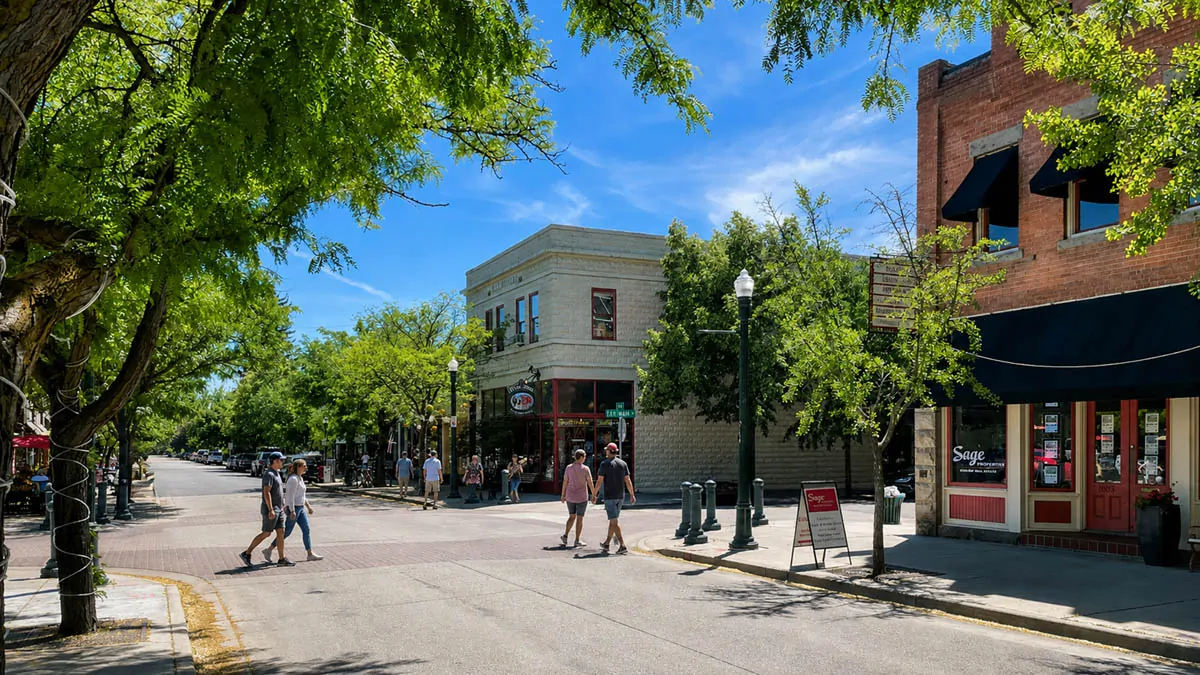
Physical structure brings those middle levels into daily experience. A neighborhood center might be a commercial corner, a school, a library branch, a park, a market, a church, a trailhead, or a meeting room. Its value comes partly from the journeys it gathers. People approach from different directions and at different times. Parents arrive with children. Older residents walk over. Someone stops for coffee before work. Another person passes through on the way home. Over months and years, overlapping routines turn strangers into recognizable figures in one another’s days.
The routes leading to those destinations affect the pattern as well. A short walk to buy bread produces a different day from a drive across several miles of commercial roads. A child who walks or bikes to school learns where the crossings are, which houses have dogs, who leaves early for work, and where friends turn toward home. An older resident within easy walking distance of a shaded bench, café, garden, or public hall has regular opportunities to see other people without arranging an event around it.
Porches, stoops, benches, low walls, shaded edges, and modest plazas extend those opportunities. They give people somewhere to spend a few minutes without buying anything or announcing a social intention. Someone might read, rest, watch a child play, exchange a few words, or simply sit. The useful standard is social contact without forced exposure: enough common ground for recognition to develop, with enough privacy that residents remain free to withdraw when they choose.
Roads and other barriers undo these conditions even when destinations remain close. A six-lane arterial may separate two areas whose homes are only a few hundred yards apart. Large parking fields, blank commercial edges, disconnected street networks, missing sidewalks, and difficult crossings increase the effort required for minor trips. People begin to drive journeys they might otherwise make on foot. Parents transport children who could have moved independently under safer conditions. Older residents avoid crossings that feel hurried or exposed. Fewer people are outside, so fewer incidental meetings have a chance to occur.
This changes the amount of daily maintenance individuals have to arrange for themselves. Adults receive advice about keeping friendships alive, building support networks, managing stress, exercising regularly, setting boundaries, sleeping better, and protecting mental health. Much of that advice is sensible. It arrives, however, in lives where connection and movement often have to be scheduled deliberately after work, school, childcare, errands, and commuting have consumed much of the day.
Rogers belongs in this story as a humane response to that pressure. He gave children language for feelings, patience with difficulty, and the assurance of return. Through television he also recreated many external supports that make those lessons easier to absorb: a stable room, recurring rituals, recognizable roles, and people who came back. Personal skills help people live well. The task is harder when the surroundings consistently make movement, contact, orientation, and trust difficult.
Health is one place where these accumulated conditions show up. A 2024 Centers for Disease Control and Prevention paper estimated that 129 million Americans live with at least one major chronic disease. U.S. healthcare spending reached $5.3 trillion in 2024, and the Consumer Financial Protection Bureau has estimated that roughly 100 million Americans owe medical debt.
Those figures arise from many causes. Genetics, diet, pollution, income, medical prices, insurance design, access to care, sleep, and other conditions all contribute. Public-health agencies also recognize social connection and the built environment as part of the picture. The U.S. Surgeon General has pointed to transportation, zoning, housing, parks, libraries, and other social infrastructure as conditions that support or hinder connection.
No single sidewalk explains a national health statistic. Daily routines still accumulate over years. A safe route affects whether a child walks somewhere alone. A nearby market affects whether an errand requires a car. Shade affects whether an older resident is likely to walk on a hot afternoon. A neighborhood hall or gathering place affects how often people see others without making an appointment. The consequences of each decision are modest in isolation, but together they help establish the ordinary conditions in which people move, eat, rest, meet one another, and grow older.
Boise offers a local example of how inherited rules change before the physical city catches up. The city’s legacy zoning code was first adopted in 1966, during the same broad period when separated land uses and automobile-oriented development grew common across the country. It was amended many times over the following decades. Its comprehensive replacement in 2023 changed the legal framework in important ways, creating more room for housing variety, mixed uses, connected pathways, and neighborhood centers bringing everyday destinations closer together.
Those permissions now operate inside a city whose streets, parcels, parking lots, walls, institutions, and habits were formed over many years. A neighborhood store may be possible where regulations once made it difficult, while the walk to that store still crosses a hostile road. More homes may be allowed near a local center even when the center itself remains weak or disconnected. A pathway may appear in a plan and still require land, money, maintenance, and a responsible party who keeps it usable.
In practice, the next gains will come from strengthening local centers that residents already use, connecting homes with schools, shops, parks, and public rooms along routes people actually choose, and giving common spaces clear stewardship. A neighborhood works better when someone knows the condition of its meeting room, path, garden, or public edge, understands who controls the relevant pieces, and follows a modest repair from the first report to completion. Residents learn that middle scale through use and through seeing responsibility exercised there; a planning label alone supplies very little of that experience.
Friendship remains personal within such a neighborhood. Some residents will know one another well, others only by face, and others hardly at all. What the physical setting can supply is a prior sense of membership. Residents know the nearby routes, recognize where local activity gathers, encounter the same faces over time, and understand that the area outside the front door belongs to a larger human setting rather than an anonymous remainder between private parcels.
Children already live with a version of this arrangement at school. The classroom establishes who the classmates are, then leaves friendship to develop according to personality, affection, conflict, and time. A flourishing city offers adults a similar sense of membership while leaving plenty of room for private life. Familiar paths, nearby destinations, occasional conversations, and people responsible for common ground give residents ways to participate lightly and return home when they have had enough.
Fred Rogers’s question will always carry an invitation, because kindness and friendship still depend on choice. The city has a quieter task before that choice begins.
It can make neighbor true before anyone has to ask.
