
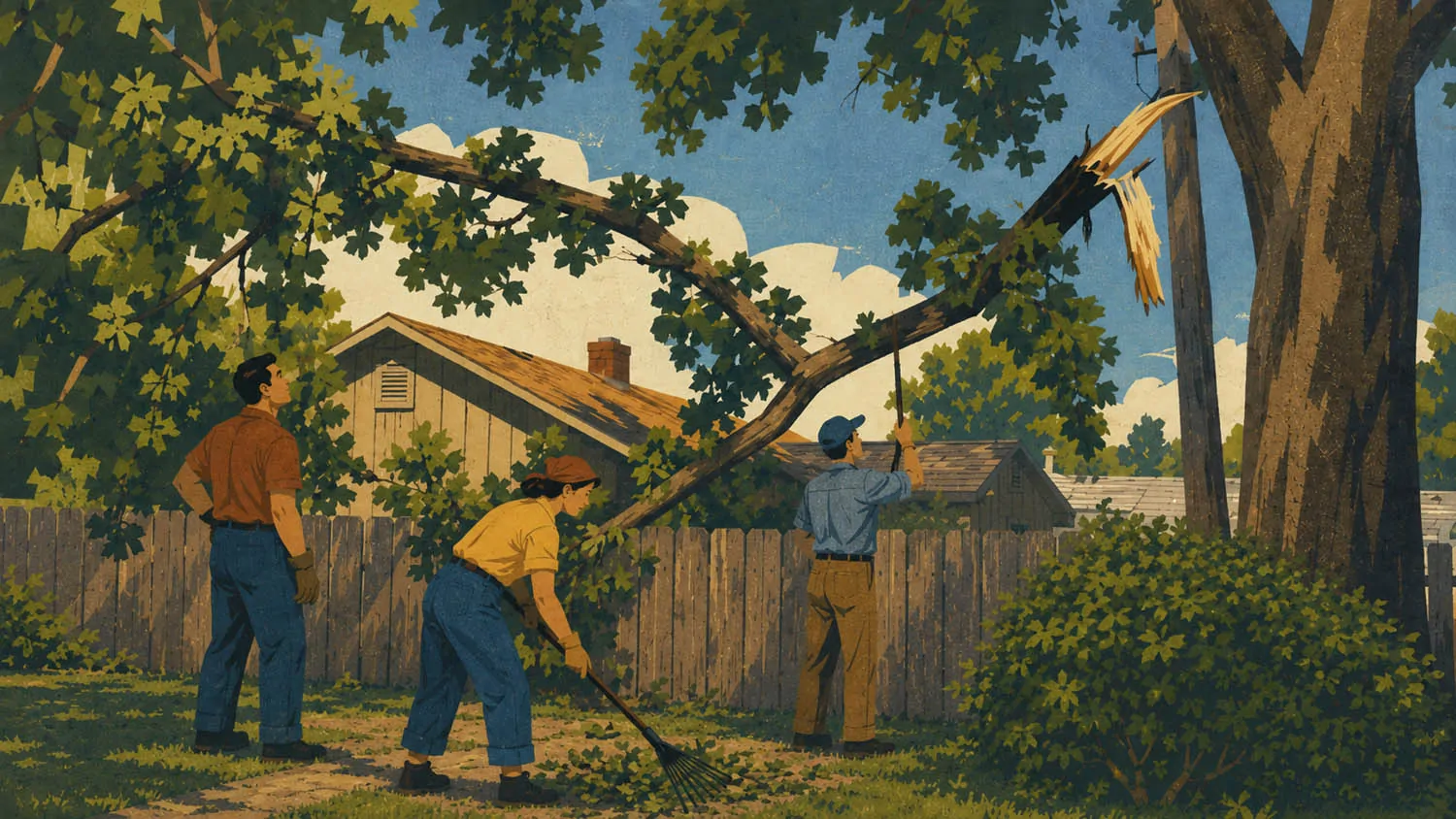
A hard summer wind moves through a Boise neighborhood. The first gusts shake dust from the trees. Then a cottonwood limb comes down across the alley, taking part of a fence with it and blocking the route between two rows of garages.
For a few minutes, people stand outside and take in the damage. Then the garage doors begin to open.
One neighbor brings a chainsaw. Another drags out heavy gloves and a pruning saw. Someone moves a truck to make room for the branches. A teenager pulls smaller pieces toward the curb while two adults lift the heavier sections. People who usually exchange a wave from behind a windshield are suddenly discussing where to cut, who can carry what, and which part of the fence can wait until morning.
The work needs no campaign, committee, or speech. Everyone can see the problem. The fallen limb has a clear boundary, the alley has to reopen, and progress can be measured in feet of exposed pavement. When the last section is hauled away, everyone knows the job is finished.
Emergencies have a strange capacity to make cooperation feel natural. Disaster researchers have repeatedly found that people often become highly prosocial after a shared shock. Neighbors check on one another, volunteers form working groups, and strangers offer food, transport, tools, information, and shelter. The familiar story of mass panic misses much of what people actually do.
Conflict, fear, opportunism, and unequal burdens still appear. A crisis can expose every weakness a community carries. It also removes much of the ambiguity that suppresses action during ordinary time. The damage is visible. The need authorizes people to step forward. Work can be divided around the scene, completion has a recognizable form, and care suddenly has an address.
By the weekend, the alley is open. The fence has a temporary patch, the saws are back on their shelves, and the neighbors return to familiar routines. The same part of the city now holds another kind of damage, one that may remain for years.
A bus stop bakes in the afternoon sun, and the bus still arrives. A narrow sidewalk pushes a stroller close to traffic, yet the route remains technically passable. At a foothills access point, erosion and confusing signs make arrival harder while the trail stays open. A public meeting room drains attention, and the agenda still reaches its final item.
Each place works well enough to avoid becoming an emergency. That narrow success allows the underlying condition to persist.
The daily consequences are small enough to absorb individually. A rider stands farther back from the road. A parent chooses another route. A first-time visitor studies several signs and hopes for the right trail. A resident stays home from the next public meeting. People adapt because adaptation is faster than discovering who owns the problem, who has authority to change it, and whether anyone else sees the same thing.
These adaptations hide the evidence. Fewer riders at an exposed stop can look like low demand for transit. An unpleasant sidewalk can look adequate because few people use it. A confusing trailhead can appear functional once newcomers learn its unwritten rules. The cost is transferred to each person, and their workaround can then be mistaken for proof that the system is working.
Much civic neglect lives in this space between comfort and collapse. The place remains usable, so urgency never gathers. Responsibility is dispersed across agencies, property lines, maintenance contracts, easements, budgets, and approval processes. A resident experiences one place, while the institutions responsible for it may see several separate jurisdictions.
The fallen branch creates its own unit of responsibility. It lies here, it blocks this route, and these hands can move it. A degraded public place arrives without those boundaries. The problem may be visible, yet action remains risky and uncertain. A neighbor can cut a limb in the alley with a reasonable sense of what the work requires. Changing a bus stop, crossing, trailhead, or public room may involve ownership questions, design standards, liability, funding, and permission that no single person can resolve.
Emergency also grants social permission. The person with the chainsaw can enter the scene without explaining why the alley deserves attention. Urgency protects the work from concerns about overreach, misplaced priorities, or whether the problem is serious enough to warrant attention. Ordinary stewardship lacks that cover. Someone who raises concerns about a hot bus stop or confusing crossing may first have to defend the legitimacy of noticing it.
That social cost favors late action. Once damage becomes dramatic, concern looks responsible. Earlier concern can look excessive because the feared outcome has not arrived. Public gratitude gathers around the crew that clears debris, while the person who waters young shade trees, updates a worn sign, or keeps a drainage channel open works with little recognition. Those ordinary acts determine how much damage the next emergency will bring, but when responsibility and authority remain unclear, waiting can feel like the only reasonable response.
This helps explain why communities can appear apathetic during ordinary time and remarkably generous after a disaster. The underlying capacity has remained. Emergency supplies the structure that daily civic life lacks: a shared view of the damage, permission to act, a bounded task, and a visible finish line.
Clara Barton understood the value of that structure. During the Civil War, she carried supplies and care to wounded soldiers. She later brought relief to civilians during the Franco-Prussian War and founded the American Red Cross in 1881.
Barton helped give scattered compassion a reliable form. Donated food and clothing needed appeals, storage, transport, records, volunteers, and trusted leadership. Her organization made scattered willingness dependable.
Ordinary civic life needs a similar kind of organizing discipline before emergencies arise. Responsibility for a dangerous crossing should become clear while repair is still preventive. The owner, the standard, the cost, and the next action for a public space can be assembled while the place still functions. The capacity to help already exists among residents, donors, designers, public employees, businesses, and neighborhood groups. It becomes useful when the work is given a legible form.
This is stewardship solidarity: care organized before damage becomes catastrophic.
Its work rarely produces a dramatic rescue. Someone documents the exposed bus stop and identifies the agency responsible for the right-of-way. A small group establishes a better shade standard, develops a credible design, estimates the cost, and finds a partner able to maintain it. Donors can see what their contribution would build. The public agency receives a developed proposal with a defined problem, scope, and next step. Riders gain a place designed for the fact that waiting is part of the trip.
The same sequence can apply to a broken path, a neglected corner, an eroding trailhead, or a room that makes participation harder than it should be. First the condition becomes visible as a whole. Then ownership and constraints are mapped. A responsible next step is defined at the scale people can actually carry. Funding, authority, skill, and local knowledge can then gather around a specific piece of work.
This is the kind of stewardship Boise Rising is trying to practice: noticing conditions that remain below the threshold of crisis, showing why they matter, and creating a credible path from recognition to repair. Care becomes more useful when people can see where their attention, money, authority, or labor can enter the work and when the work is built to last beyond one burst of effort.
This approach also changes the meaning of “good enough.” Bare function stops being the final measure. Better questions begin with how a place carries people through a normal day. Can an elder wait there safely in July? Can a child understand the route? Can a first-time visitor arrive without anxiety? Can a meeting room hold attention long enough for citizens to think together? Can someone report a problem and find a known path toward action?
These are modest questions until their absence accumulates across a city. Then the burden appears as avoidance, exhaustion, distrust, and public spaces that fewer people choose to use. Stewardship notices that burden while the repair is still manageable.
Back in the alley, the fallen limb is gone. The capacity revealed by the storm remains in the garages and living rooms along the block: tools, judgment, strength, local knowledge, and a willingness to help when the need is clear. Boise already possesses that capacity. The task is to give it clear objects, trusted structures, and work with a visible finish line.
Disaster reveals that people still know how to act together. The work now is to stop waiting for disaster to prove it.
